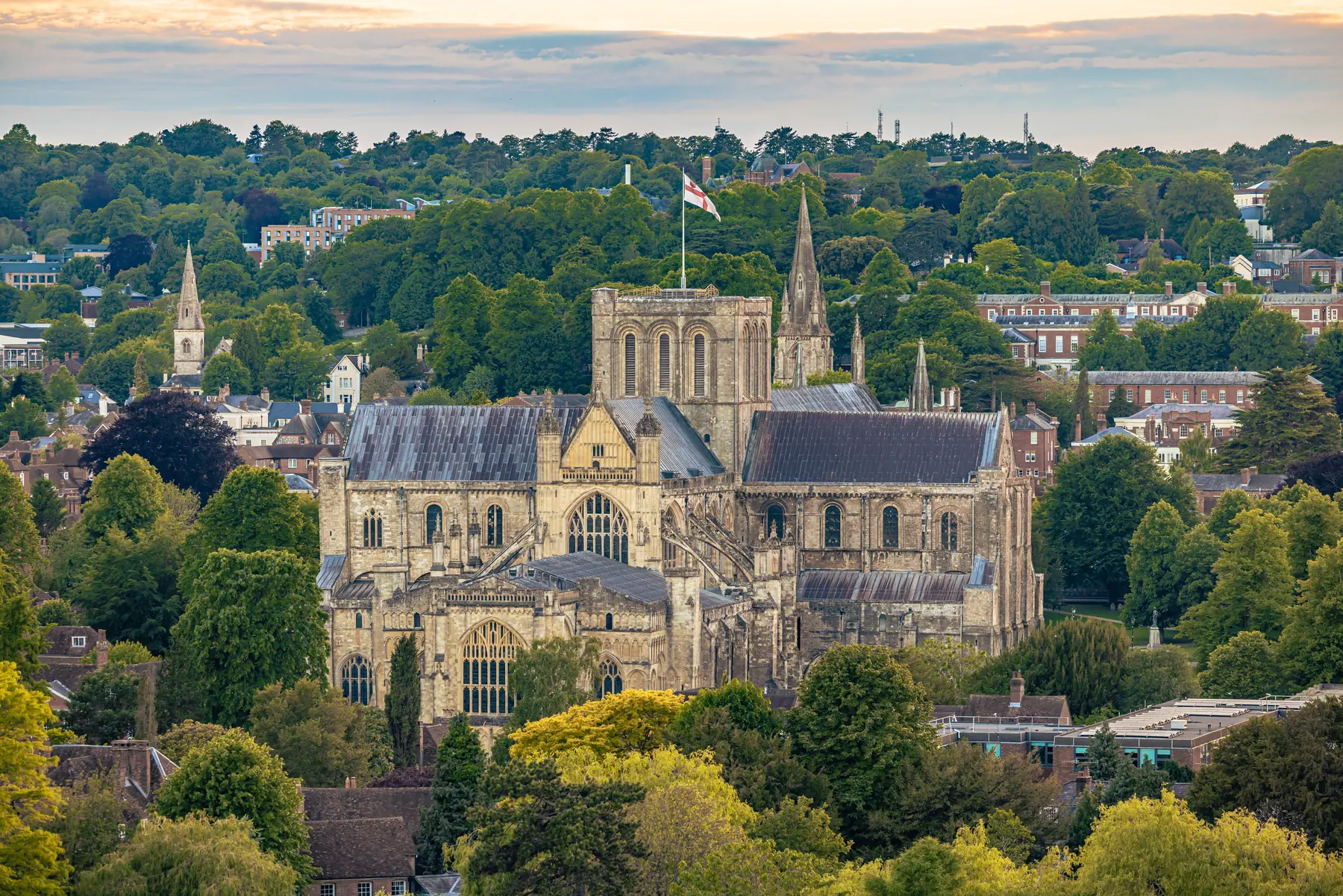
Winchester is sixty miles from London, fourteen from Southampton and about forty minutes from the coast, sitting at the western end of the South Downs with the New Forest to the south-west and Salisbury Plain to the west. It is one of the better-placed small cities in England for days out, and the railway does most of the work.
Eleven kilometres east. Alresford is a Georgian market town built around a broad main street, with the watercress beds that give the railway its name still in production.
The Watercress Line — the Mid Hants Railway — runs sixteen kilometres of steam railway from Alresford through Ropley and Medstead to Alton, climbing what was known to enginemen as “the Alps”. It is one of the best-run heritage lines in the country, with dining trains, Thomas events and a proper engineering operation at Ropley.
Twenty-five kilometres east. Jane Austen’s House at Chawton is the cottage where she spent the last eight years of her life and wrote or revised all six of her novels. It is small, plain and much more affecting than a grander house would be. She is buried in Winchester Cathedral, which makes the two a natural pair.
Chawton House, her brother’s manor next door, is open with a library of early women’s writing.
Forty minutes by train or road. Portsmouth Historic Dockyard is the day out: HMS Victory, the Mary Rose in her purpose-built museum, HMS Warrior, the harbour tours and the naval museum. It is easily a full day and largely indoors.
Add the Spinnaker Tower, Southsea and the D-Day Story and it is two.
Twenty-three kilometres, fifteen minutes by train. SeaCity Museum with its Titanic galleries — the ship sailed from here and a large proportion of the crew were Southampton men — the Tudor House, the surviving medieval walls and a city’s worth of shopping.
Ferries from Southampton, Portsmouth and Lymington. Osborne House, Queen Victoria’s seaside palace; Carisbrooke Castle; the Needles; and some of the best-preserved Victorian resort architecture in England. It is a long day but a straightforward one.
Forty minutes. A medieval royal hunting forest that became Britain’s newest national park, with ponies and cattle grazing freely on the open heath and roads, ancient woodland, and villages that have not changed much.
Lyndhurst is the capital, Beaulieu has the National Motor Museum and the abbey, Buckler’s Hard is a preserved eighteenth-century shipbuilding village on the river, and Brockenhurst and Burley are the classic villages.
The cycling in the forest is exceptional and hire is available everywhere.
Salisbury, an hour west, has the cathedral with the tallest spire in Britain, one of the four surviving copies of Magna Carta in its chapter house, and the medieval close around it. Old Sarum, the abandoned hilltop original of the city, is on the edge of town.
Stonehenge is fifteen minutes further, with a substantial visitor centre. Avebury, its larger and quieter counterpart, is another half hour north and is free.
Basingstoke is on the line north and is largely a modern town, but The Vyne and Basing House nearby are both worth a visit.
Highclere Castle, forty-five minutes north, is the house that plays Downton Abbey and opens seasonally.
Oxford and Bath are both about two hours, and London is an hour by train, which makes a day in the capital entirely practical.
Old Winchester Hill, eighteen kilometres south-east, is a chalk hillfort and national nature reserve with a view to the Isle of Wight.
Bishop’s Waltham, fourteen kilometres south, has a ruined bishop’s palace and a good high street.
Stockbridge and the Test valley, twenty kilometres west, are chalk stream country and the heart of English fly fishing, with a National Trust down above.
Romsey, fifteen kilometres south-west, has a Norman abbey and Broadlands, Mountbatten’s house.
Winchester is on the South Western main line with four trains an hour to London Waterloo in about an hour, and south to Southampton in fifteen minutes, Southampton Airport Parkway in ten, Bournemouth and Poole. Change at Southampton for Portsmouth and the Isle of Wight ferries, and at Basingstoke or Woking for Salisbury and the west.
The New Forest is reachable by train — Brockenhurst and Beaulieu Road stations are in the middle of it, and Beaulieu Road in particular is a station in open heath with ponies on the platform approach.
Buses reach Alresford, the Meon valley, Romsey and Stockbridge. Our getting here page has more.
The dockyard day, by train. Winchester to Portsmouth Harbour, straight into the Historic Dockyard for the Mary Rose, HMS Victory and HMS Warrior, with a harbour tour if there is time. Home in the evening. Entirely by rail and a full day.
The Austen day. East to Chawton for Jane Austen’s House — the cottage where she wrote or revised all six novels — and Chawton House next door, then on to Alton for the Watercress Line back towards Alresford. Ending with her grave in Winchester Cathedral closes the circle.
The forest day. South-west to the New Forest: Lyndhurst, Beaulieu for the Motor Museum and the abbey, Buckler’s Hard on the river, and the open heath with the ponies on it. Reachable by train to Brockenhurst, with bike hire at the station.
The M3 runs past Winchester and makes the north and south easy; the A31 and A272 west and east are slower. The genuine pinch points are the New Forest on summer weekends and Portsmouth’s dockyard, which books out in the school holidays.
The train is frequently the better option: four services an hour to London and Southampton, fifteen minutes to the airport, and connections to Portsmouth, Salisbury and the coast.
Hampshire gives you options. Wet days are for Portsmouth’s dockyard, Southampton’s SeaCity or the train to London, all of which are largely indoor and all under an hour. Clear days belong in the New Forest, on the South Downs Way or at Old Winchester Hill, where the views are the point.
Winter is the New Forest’s best season — the ponies come down onto the roads, the tourist traffic disappears and the heath in low sun is at its most striking. The Watercress Line runs a full winter programme too, and a steam train through frosted water meadows is a better proposition than the same trip in August.
Portsmouth Historic Dockyard for a full day; the Watercress Line and Alresford for a half; the New Forest if you want countryside.
About forty minutes south-west by road, and reachable by train to Brockenhurst.
Yes — about an hour and a quarter by road via Salisbury, or by train to Salisbury and the tour bus from there.
At Chawton, twenty-five kilometres east near Alton. She is buried in Winchester Cathedral, which makes the two a natural pair.
About an hour to Waterloo, with four trains an hour.