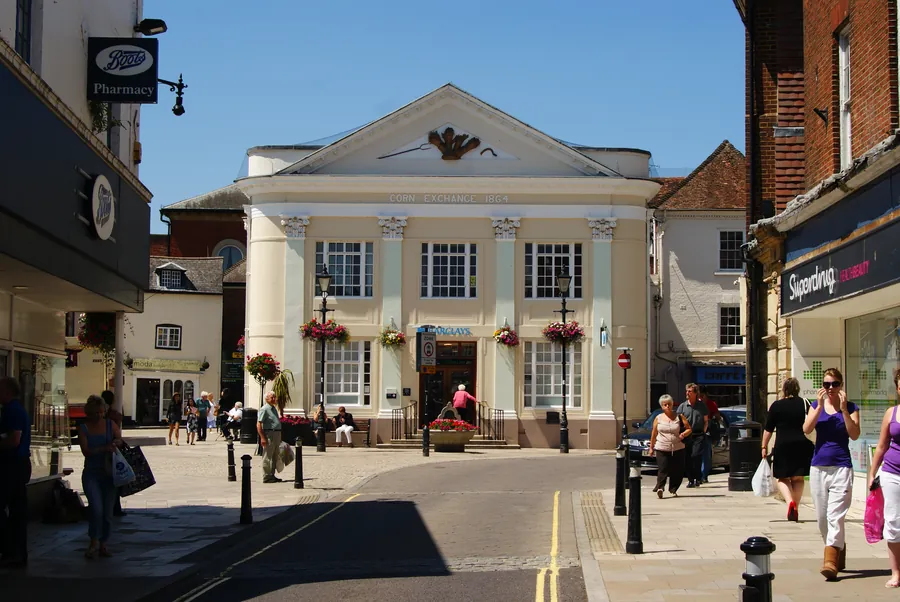
Romsey is a town, not a village — 14,768 people in the parish at the 2011 census — on the River Test in the Test Valley district of Hampshire. The reason to make the trip from Winchester is the abbey. Romsey Abbey is the largest parish church in Hampshire, cathedral-like by the reckoning of architects and observers, and it was probably designed by Henry of Blois, the man who built the Hospital of St Cross in Winchester. Around it is a working market town whose centre was remodelled in 2019, when the roundabout around Lord Palmerston’s statue was removed and the streets pedestrianised.
The straight-line distance is 15.1 km. It sits on the outskirts of the New Forest, just over 3 miles (4.8 km) northeast of its eastern edge.
The Guardian called Romsey “resoundingly, timelessly English” in 2014, and it is popular among retirees. What it offers is one exceptional building, a country house where two royal honeymoons were spent, and a history of wool and beer.
The first church here was founded by Edward the Elder in 907 for his daughter Ælflæd, who became Romsey’s first abbess. The Danes sacked the town in 1003 and destroyed it. The building standing now is Norman, put up between 1120 and 1140 in Chilmark stone and finished with three more arches by 1240. The north transept of the Saxon church survives, along with a 10th-century rood.
Henry VIII suppressed the abbey in 1539; the townspeople bought the church from the Crown in 1544 and it has served as the parish church ever since. There is a Winchester thread in it: when William Rufus was killed hunting in the New Forest in 1100, his body was carried through Bell Street on its way to Winchester Cathedral.
It holds 4.8 from 812 Google reviews, is open daily to visitors, and has a donation box inside. Reviewers rate the volunteers as much as the fabric: a visitor in May 2026 wrote, “We were lucky to have a wonderful gentleman give us a 5 minute story about the Abbey and what to look out for.”
King John’s House has a misleading name. It was built in 1256, some 40 years after the king died. The oddities are the draw: 14th-century wall decorations and graffiti, a floor of cattle metapodials, a monastic garden. It is Grade I listed, and it was damaged by fire in February 2025.
That matters for planning. It carries 4.5 from 184 Google reviews, but the reviews describing the interior pre-date the fire: a visitor in February 2025 wrote, “Visited King John’s House on a day trip to Romsey from Winchester, we thought it is one of the nicest places around.” A visitor in August 2025, after the fire, reported only that “Gardens are still open and worth a short stroll or when you need time to switch off.” Check what is open inside before making a special journey.
War Memorial Park, 4.7 from 1,318 Google reviews, is the other easy stop: a café, and a Japanese Type 96 15 cm howitzer brought back to Romsey by Louis Mountbatten. A visitor in July 2026 advised, “Take a left and walk to a mill and fresh water where fish are” — that is Sadler’s Mill, the only mill ever developed on the main course of the Test, restored in 2005.
Romsey Rapids, the swimming complex, is the wet-weather option and also the town’s most reviewed but lowest rated attraction, at 4.0 from 2,241 Google reviews.
Broadlands is an 18th-century country house just outside the centre, Palladian, designed by Capability Brown and completed by Henry Holland in 1788. Lord Palmerston lived there in his later years; he had hoped to be buried at Romsey Abbey but was given a state funeral and Westminster Abbey in 1865. His statue in Market Place was sculpted by Matthew Noble, raised in the 1860s.
The house later belonged to Louis Mountbatten, buried in the abbey after he was killed by an IRA bomb on 27 August 1979. Elizabeth II and Prince Philip spent their honeymoon at Broadlands in 1947; Charles and Diana spent the first part of theirs there in 1981.
The catch is access: house and gardens open in summer only, and on weekdays rather than every day. Broadlands has 4.4 from 116 Google reviews, a thinner sample than the abbey’s. The Romsey Agricultural & Horse Show, held annually since 1842, takes place on the estate in September.
Domesday recorded 127 households in 1086, along with the watermills that later made Romsey an industrial town. Its medieval money came from wool — woven, fulled, dyed, then exported through Southampton — until the Black Death of 1348–9 killed up to half a population of roughly a thousand. In 1643 William Waller, having taken Winchester for Parliament, marched southwest; his soldiers defaced the abbey and destroyed its organ.
When the woollen trade failed in the 18th century, brewing replaced it, thoroughly. By 1911 the town had more than 80 public houses, twice the national average and one for every 151.5 residents, the origin of the Hampshire line “so drunk he must have been to Romsey”. Corn money built the Grade II* Corn Exchange in 1864, and the railway arrived in 1847 without reviving growth. One survivor of that age is open: the signal box, built in 1865 and working until 1982, rescued from demolition and run as a museum, 4.9 from 73 Google reviews.
Bus is the direct link. Stagecoach runs services between Romsey and Winchester, with Bluestar covering the town itself, Southampton and Eastleigh. The pack gives no frequencies, so check before travelling. A shuttle bus connecting Romsey with the fast London trains at Winchester was discontinued in 2009, despite a campaign to save it.
Rail does not help much. Romsey has a station managed by South Western Railway, but the listed services run to Salisbury via Southampton and Eastleigh, with Great Western Railway’s Cardiff to Portsmouth trains calling via Southampton and Fareham. Winchester is on neither route as described.
By road, the town is within 10 miles (16 km) of both the M27 and the M3. Cyclists have route 24 of the National Cycle Network, but it runs to Southampton and Salisbury, not Winchester.
The village and what is around it, at walking scale.
Open any of them in Google Maps for directions and current opening.
Want live prices and dates? GetYourGuide's booking widget shows them, and sets their cookies in your browser when it loads.
Background on Romsey draws on its Wikipedia article, text there being available under CC BY-SA 4.0.