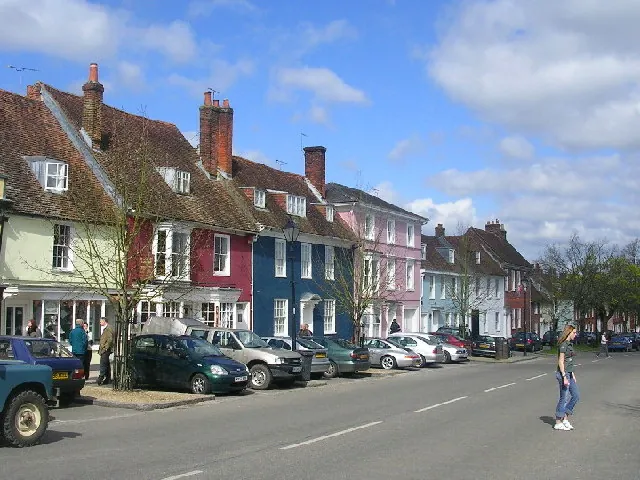
New Alresford — locally just Alresford — is a market town and civil parish in the City of Winchester district, with the River Alre along its northern edge. It was a bishop’s property speculation that worked: founded as a market town in 1189, burnt down more than once after the Civil War, and rebuilt in the Georgian brick that still lines its two main streets. The high street holds shops, tea rooms, pubs and a tourist information centre.
The reason to come out from Winchester is the railway. Alresford station is the western terminus of the Watercress Line, the preserved Mid-Hants Railway, named for the trains that took locally grown watercress up to London. The town is recognised as the Capital of Watercress and holds a festival for it.
The straight-line distance from Winchester is 11.2 km.
The heritage line runs steam and diesel trains and is the town’s main draw by a wide margin: 4.7 from 3,312 Google reviews, against a few dozen for anything else here. The direction matters. The other end is Alton, itself the terminus of the Alton line and how visitors from London reach it; nothing runs west to Winchester. The line was a secondary main line of the London & South Western Railway between Alton and Winchester, closed in 1973, and only the Alresford–Alton section was preserved.
Nor is every train a steam train. A visitor in July 2026 wrote, “Shame the train was not steam but due to this we have been invited back for a second time.” Event days change the visit; a visitor in August 2026 described a “Day with Thomas and Friends” and warned, “At first we thought we would able get pictures closely with Thomas and friends but it wasn’t.” The same review is positive on practicalities: “There were lots of parking spaces, picnic areas, tasty ice cream.”
The town is a T-shaped conservation area of three streets — Broad, East and West — two classical, dense Georgian streets. That date is not a style choice. In the 17th century Alresford made news as a dangerous place to live because of uncommonly frequent fires; one in 1689/90 destroyed 117 houses along with the church and the Market House, another followed in 1710 and a “like calamity” in 1736. Most of what stands was rebuilt in the 18th century.
Along them are the Swan and Bell hotels, jewellers, wine merchants, butchers, dress shops, the Alresford and Candover galleries and tea rooms; the largest of three other pubs is the Globe Inn, by one of the stream channels and the play area. The church of St John the Baptist was rebuilt in 1898 by Sir Arthur Blomfield, keeping its 14th-century tower.
Two busier listings are not on the historic streets. Chocolate Craft, 4.9 from 148 Google reviews, runs workshops rather than a counter: a visitor in May 2026 described a “Chocolate Craft 2 hour workshop” and coming away “with a box of 21 hand crafted chocolates”. Long Barn, a garden centre with lavender gardens, a café and shops, carries 4.4 from 849 reviews; a visitor in July 2026 noted “Plenty of free parking on site”, and another that month that “The shops are bit pricey”.
Founding the town involved damming the river. The Great Weir, an earth dam south of Old Alresford, held back the Alre to form Alresford Pond on the north side of the town, now the centre of a 30.2-hectare (75-acre) biological Site of Special Scientific Interest. A medieval stone bridge said to date from about 1190 still stands there, carrying the pond’s main outflow; the overflow drops down a stepped cascade at Mill Hill on its way to the River Itchen.
About 220 yards (200 m) west along the river path is the Fulling Mill, a Grade II listed 17th-century half-timbered house with the mill race underneath; it worked when wool was the dominant local industry and has been a dwelling since the early 19th century. A memorial further along it marks Hambone jr., mascot of the US 47th Infantry Regiment, stationed here in 1943–44.
Alresford Recreation Ground, 4.5 from 75 Google reviews, is where the water is most easily reached — a visitor in July 2026 wrote, “Beautiful chalk stream , peaceful , feed the ducks with your children.” The ground is not always easy: a visitor in April 2025 called it a “Beautiful walk and a challenge if you do not have an off-road buggy. Very popular and busy.”
The name is Old English alor and ford, the ford at the alder tree; the Anglo-Saxon charters using it mean Old Alresford, the older settlement over the river that Domesday lists. The new town was the idea of Henry de Blois, Bishop of Winchester and brother of King Stephen; his successor Godfrey de Lucy carried the layout through. It was one of the bishop’s six new towns and his most profitable. Trade ran on wool and leather, and in the 14th century the sheep markets here were said to produce one of the five highest turnovers in England. In the spring of 1644 the Battle of Cheriton, fought on Cheriton Down, reached its outskirts.
Several dates anchor the year. The Watercress Festival falls on the third Sunday in May, with a street market of local food, and draws a large crowd. The agricultural show, founded in 1908 and held at Tichborne Park, is on the first Saturday in September; entry is chargeable. A one-day street fair closes Broad Street to traffic on 11 October, Old Michaelmas Day, or the first Thursday after; the funfair must be gone by dawn the next morning.
By bus, Stagecoach in Hampshire runs two routes through the town: the half-hourly 64 between Winchester and Alton via New Alresford, now covering the full route of the discontinued 64X, and the more limited 67 between Winchester and Petersfield. Winchester’s buses leave from the bus station on The Broadway, 0.2 km from the city centre.
By road, the town sat on the A31 between Guildford and Winchester — a turnpike toll road built in 1753 towards Southampton, parts of it Roman road before that. The A31 now bypasses the town, and the old road through it has been redesignated the B3047.
There is no national-network station: the platform near the centre belongs to the preserved Watercress Line, whose trains run towards Alton, the opposite direction from Winchester.
The village and what is around it, at walking scale.
Open any of them in Google Maps for directions and current opening.
Want live prices and dates? GetYourGuide's booking widget shows them, and sets their cookies in your browser when it loads.
Background on New Alresford draws on its Wikipedia article, text there being available under CC BY-SA 4.0.