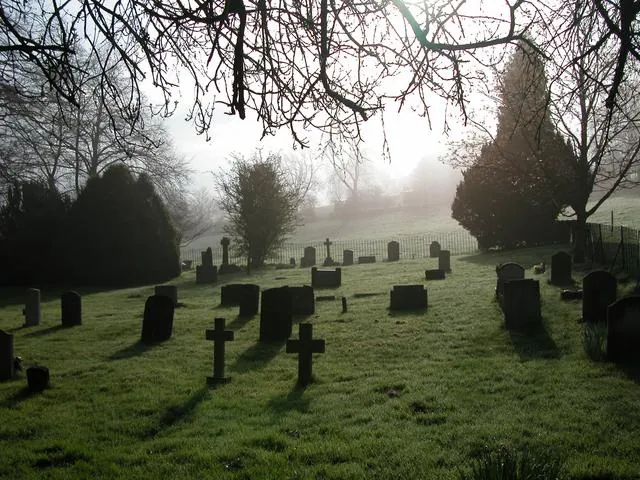
Bramdean is a village and former civil parish in the Winchester district of Hampshire, now part of the merged parish of Bramdean and Hinton Ampner. It is a linear settlement: houses strung along the A272, a busy trunk road, rather than gathered round a green. It is also small — before the 1932 merger, the parish recorded 244 people in the 1931 census.
Two things bring people out from Winchester, and neither is on the village street. The first is the National Trust property at Hinton Ampner, the other half of the parish and by review count far the busiest place in it. The second is the village’s own oddity: its church stands isolated on the south side of the A272, cut off from the settlement it serves, because the medieval village that once surrounded it is gone.
The straight-line distance from Winchester is 13.1 km.
The National Trust’s Hinton Ampner carries 4.5 from 4,017 Google reviews — against no rating at all for Bramdean House, the only other attraction listed in the parish. It is why most cars turn off here.
Reviewers agree on the grounds and divide on the house. A visitor in August 2026 wrote, “A slightly unusual NT property in that it was rebuilt in the 1960’s after a devastating fire. Nice gardens, and good cafe and shop.” Another that month went the other way on the interior — “house and contents not to my taste but gardens and terrace lovely” — and found the café area very busy at lunchtime on a Saturday.
Others found the house the best of it. A visitor in August 2026 described an “Amazing mansion filled with the history, original furniture, lots of artworks”, credited “Very knowledgeable and engaging volunteer guide’s”, and set the pace: “we spent at least 15 minutes in each room”. Between them the reviews describe a place that rewards a slow guided walk-through rather than an untouched historic interior.
The church of St Simon and St Jude is supposed to have originated in the 1170s, but was heavily altered in the 19th century, and the join shows from outside — the original nave and chancel rendered, the Victorian additions of flint and stone. Inside it keeps a 12th-century chancel arch with two carved leaf capitals.
It also keeps something under wraps. The church became known in the 19th century for restored wall paintings, uncovered and retouched by the rector Charles Walters. A later rector, Helier Touzel, had them covered over again, and covered they remain.
The isolation is the puzzle. The village’s oldest buildings date only to the 15th century — Manchester House, Woodcote Manor, Tanners Farm, The Old Rectory and Bramdean Farmhouse — and that absence of medieval fabric suggests the original settlement was abandoned over time, with building continuing north along Wood Lane. A map of 1676 already shows next to nothing around the church. Local legend puts the deserted village in a field beside the Fox Inn, backed by 19th-century finds of Iron Age pottery there, but no thorough excavation has ever been carried out.
Older layers lie under it: prehistoric barrows around Brockwood Park, and a Roman villa found in 1823 with two tessellated pavements, on the site of an earlier Iron Age enclosure. The name outlasts them. Bramdean appears as Bromdene in an Anglo-Saxon charter of West Meon in 932 CE, meaning the valley where broom grows.
The village’s character comes from its many large Georgian houses, several set in or beside rolling parkland with specimen trees. Most are private. Bramdean House is the exception, known for its mirror-image herbaceous borders and open on particular days of the year, with proceeds going to the National Garden Scheme; the village fete is held here each year. Check before travelling for the garden alone.
The Fox Inn, a short distance from the garage, is a 17th-century weather-boarded building, encased in brick in the 18th century and extended north, with two shepherd huts in the gardens. Sir William Waller and his troops marched through during the Battle of Cheriton in 1644, and houses here were supposedly requisitioned by both sides — claims that are hard to substantiate. One find is solid: repairs in 1893 turned up a well-preserved 1674 poster advertising a property sale at Alton under the paint. It fell to pieces when they tried to remove it, and no copy had been made.
Woodcote Manor, Grade II* listed with parts from the late 15th century, was originally granted by the king to the custodian of Winchester Gaol; it later housed the artist Edwin Austin Abbey, who extended it in 1911 with work by Reginald Blomfield. It remains a private residence.
North of the village lies Bramdean Common, known for its walks and its cottages, and the best reason to get out of the car. Standing on it is the Church in the Wood, a chapel put up in 1883 by the Reverend Alfred Caesar Bishop to serve nearby farm workers. It went up in five weeks and shows it: a timber frame on a brick plinth, encased in corrugated iron.
Brockwood Park, once a country estate, has since 1969 been Brockwood Park School, founded on the teachings of Jiddu Krishnamurti, who lived here and ran it. In its grounds stands a stone circle built in the mid-19th century by Colonel George Greenwood from local sandstone and puddingstones brought from East Tisted; accounts from the time say he built it to see how long it would take archaeologists and historians to declare it ancient. Greenwood also planted the copper beeches you pass entering the village from the east.
This is a driving trip. The material behind this guide records no bus route and no railway station serving the village, so do not assume public transport without checking locally first.
The road is the A272, and the village sits directly on it. It was widened by American troops in 1943 in preparation for D-Day, which is why a settlement this size has a road this wide through it; the A272 here is busy. That matters on arrival: the church stands on the far side, so seeing both halves of the place means crossing a trunk road.
The village and what is around it, at walking scale.
Open any of them in Google Maps for directions and current opening.
Want live prices and dates? GetYourGuide's booking widget shows them, and sets their cookies in your browser when it loads.
Background on Bramdean draws on its Wikipedia article, text there being available under CC BY-SA 4.0.