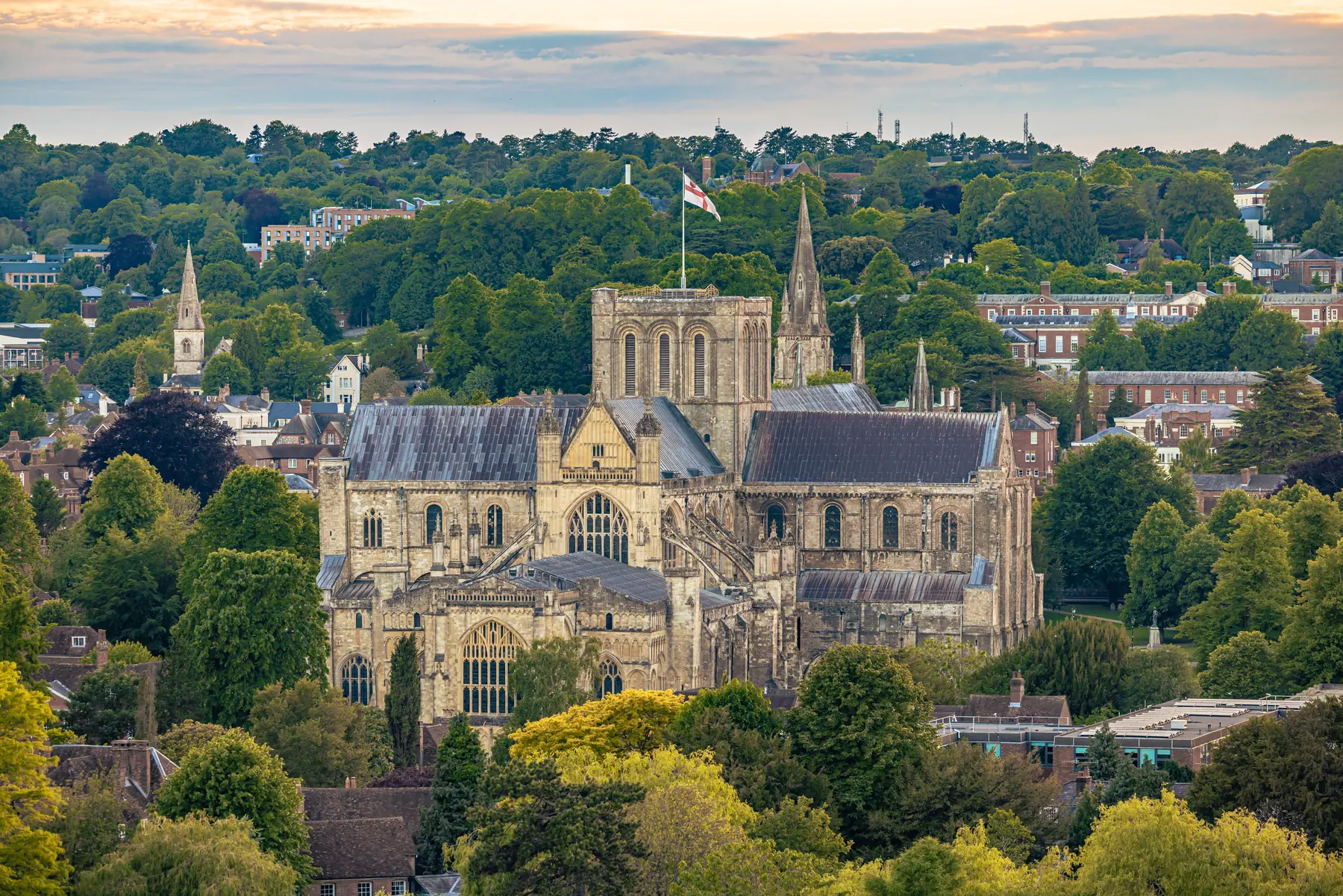
Winchester eats well. It is a prosperous cathedral city of fifty thousand people within an hour of London, with a serious food culture, one of the largest farmers’ markets in the country, and enough competition to keep standards up — and it has largely avoided being colonised by chains in the way that similar-sized towns have.
The geography is compact. Jewry Street, the High Street, Southgate Street, Parchment Street and the lanes between hold most of it, and the whole city centre is fifteen minutes end to end.
It gets its own heading because Winchester people would insist. The Wykeham Arms on Kingsgate Street, tucked between the cathedral close and Winchester College, is one of the best pubs in England: eighteenth-century, low-ceilinged, hung with school desks and pewter tankards, with proper food, a serious wine list and rooms above.
It is the pub visitors are sent to and the one residents actually use, which is rarer than it sounds. Book for dinner.
Winchester’s independent scene is unusually good for a city this size, and it turns over — a list goes out of date quickly. What is stable is where to look: Jewry Street and Parchment Street carry most of the interesting kitchens, Southgate Street has the Hotel du Vin and the smarter end, and the Broadway and High Street have the volume.
The city covers modern British, Italian, Japanese, Indian and a good deal else, and there are several places doing serious cooking with Hampshire produce.
Kyoto Kitchen on Bridge Street is the long-standing Japanese and has a strong following.
Winchester Farmers’ Market runs on the High Street twice a month and is one of the largest in the United Kingdom — well over a hundred stalls, all producers from within a defined radius, and genuinely worth planning a visit around. Hampshire cheese, watercress from the Alresford beds, trout from the Itchen and Test, cider, bread and vegetables.
There is also a general street market several days a week.
Beyond the Wykeham, the city has a good stock: old pubs in the lanes, several with rooms, and a couple of decent modern bars. The Black Boy on Wharf Hill is the eccentric one — crammed with clocks, taxidermy and objects, and worth seeing whatever you think of the decor.
The country pubs around Winchester are the real strength. The Running Horse at Littleton, the Bell at Wherwell, the pubs of the Itchen and Meon valleys and the Chestnut Horse at Easton are all within twenty minutes and several are destinations in their own right.
Lainston House at Sparsholt and the other country house hotels do the smart version.
Hampshire produces unusually well.
Watercress from the beds around Alresford, which is why the heritage railway is called the Watercress Line — the crop went to London by train. It is in season from spring to autumn and it is nothing like the supermarket product.
Trout from the Itchen and the Test, two of the finest chalk streams in the world.
Hampshire cheeses, local cider, and — increasingly — English sparkling wine, since the Hampshire chalk is the same geology as Champagne and several of the country’s best producers are within half an hour.
The cathedral close and the streets around it have the visitor version; the lanes off Jewry Street and Parchment Street have the independent coffee shops that residents use. There is a good bakery culture and several delis.
The Refectory in the cathedral close and the cafés along the Broadway cover the daytime.
Booking. Winchester fills at weekends year-round — it is an hour from London and a standard day out — and completely during the Christmas market in the cathedral close, which runs through late November and December and is one of the biggest in the country. Book in both cases.
The Hat Fair in July and the Winchester Festival also fill the city.
Timing. Weekday lunchtimes are busy with a working city; weekday evenings are the easiest time to walk in anywhere.
Getting about. Everything is within a fifteen-minute walk of the station, which has four trains an hour from London Waterloo.
Breakfast at one of the independents on Parchment Street or Jewry Street. Coffee in the cathedral close. Lunch from the farmers’ market if the day falls right — well over a hundred producers on the High Street, and the best food shopping in Hampshire — or in one of the pubs in the lanes. Afternoon tea somewhere in the close. Dinner at the Wykeham Arms, booked, or one of the Jewry Street restaurants. And a last drink at the Black Boy on Wharf Hill, which is worth seeing for the decor alone.
All of it is within a fifteen-minute walk.
Winchester fills at weekends year-round because it is an hour from London and a standard day out. It fills completely during the Christmas market in the cathedral close from late November through December — one of the largest in the country — and during the Hat Fair in July.
Book in those periods. Otherwise weekday evenings are easy and the city is at its most pleasant.
Well served. Winchester is a prosperous city with a modern food culture, and dedicated vegetarian and vegan options are standard across the independents rather than an afterthought. The farmers’ market carries producers catering for most requirements, and several of the city’s restaurants build menus around Hampshire vegetables and the local watercress.
Hampshire’s country pubs are the reason a good many Winchester residents get in a car on a Sunday. Within twenty minutes: the Chestnut Horse at Easton, the Bush at Ovington on the Itchen, the Running Horse at Littleton, the Flower Pots at Cheriton — which brews its own — and the Yew Tree at Highclere.
Stockbridge, twenty kilometres west on the Test, has an unusually good high street for a village of its size, with a fishing-tackle culture attached. Alresford to the east has good places and the watercress beds. And Lainston House at Sparsholt is the smart country-house option within ten minutes.
The farmers’ market is the headline, but Winchester also has good delis, a proper butcher and cheesemonger culture, and an independent food scene that has survived better than in most cities of its size. There is a general market on the High Street several days a week.
For a picnic on the water meadows — which is the correct thing to do here — the market and the delis on Parchment Street will do considerably better than a supermarket.
The Wykeham Arms on Kingsgate Street, between the cathedral close and the college. Book for dinner.
Twice a month on the High Street, and it is one of the largest in the UK.
Watercress from the Alresford beds, trout from the Itchen and Test chalk streams, local cheese and, increasingly, English sparkling wine.
It is a prosperous city within commuting distance of London, and the prices reflect it — but less than you would expect, and the market and the pubs are good value.
The Itchen and Meon valley villages, or the Running Horse at Littleton — all within twenty minutes.