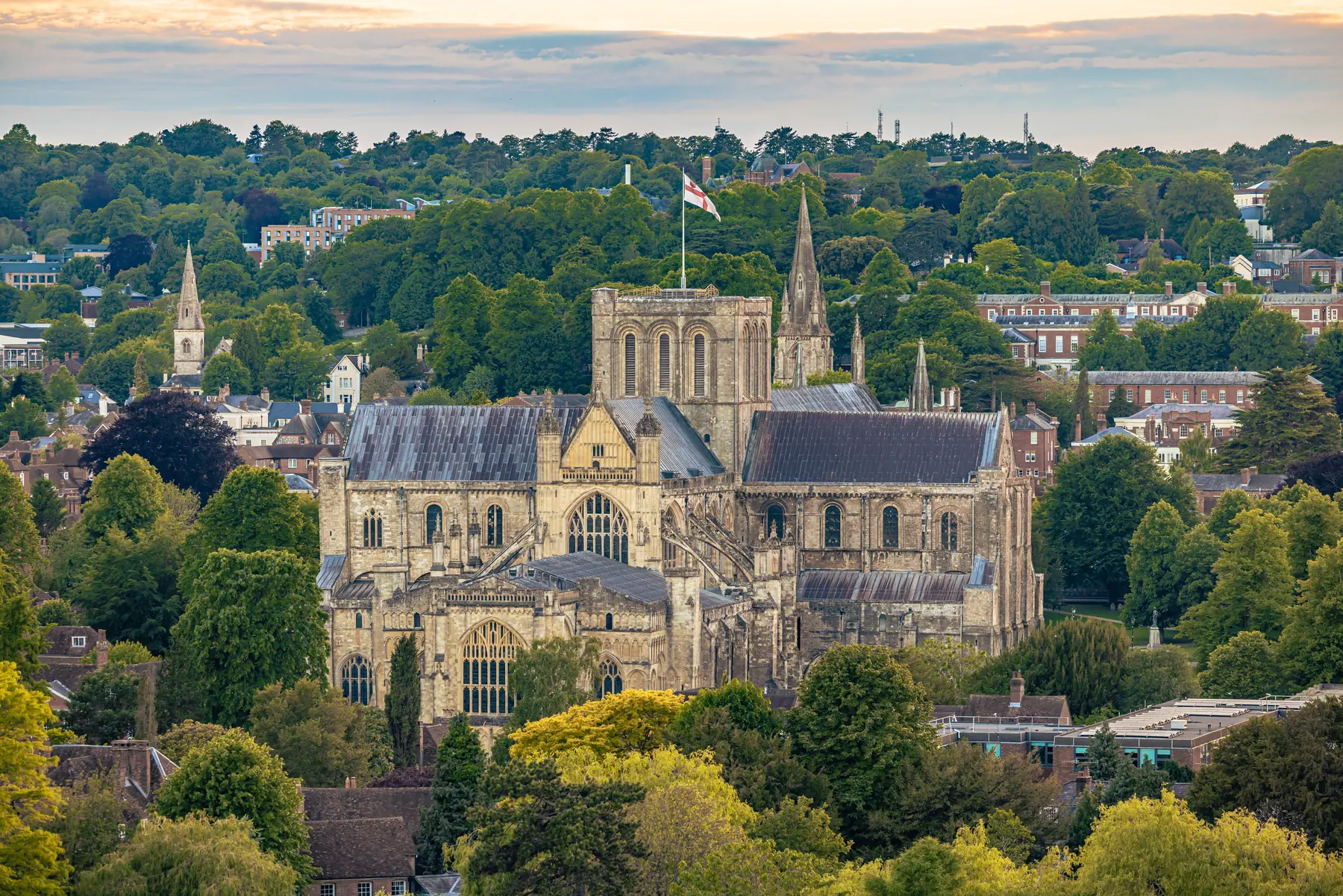
For roughly two hundred years Winchester was the most important place in England. Alfred the Great made it the capital of Wessex, his successors made it the capital of a unified kingdom, and it remained so — despite London’s growing wealth — until the Norman Conquest.
Almost nothing of that Winchester survives above ground. What does survive is a statue, an outline in the grass, a ruined abbey site, a thirteenth-century hall and a very large round table, and between them they tell the story surprisingly well.
Alfred the Great ruled Wessex from 871 to 899, held off the Danish invasions that had destroyed every other English kingdom, and then did the more remarkable thing: he rebuilt. He created a network of fortified towns, reorganised the army, built a fleet, established a system of law, and set about reviving learning in a country where, as he put it, there were very few south of the Humber who could understand the divine service in English.
Winchester was his capital and his showpiece. The street grid of the modern city centre is essentially his — a planned Saxon layout of a main street with a regular pattern of side streets, laid out inside the old Roman walls in the late ninth century and still legible today.
His statue stands at the bottom of the Broadway, a huge bronze by Hamo Thornycroft commissioned in 1899 for the thousandth anniversary of his death, with his sword raised as a cross. It is the image of the city. See our King Alfred page.
Nowhere, precisely, which is the frustrating part of the story.
He was buried first in the Old Minster, the Anglo-Saxon cathedral that stood immediately north of the present one. Its outline is marked in red brick on the grass beside the cathedral, and it is worth standing on: this is where the kings of Wessex and then of England were crowned and buried.
His body was then moved to the New Minster next door, and again in 1110 when the community moved out of the city to Hyde Abbey.
Hyde Abbey was dissolved in 1538 and demolished, and a prison was later built over the site. The graves were disturbed, and the whereabouts of Alfred’s remains are genuinely unknown — some bones excavated from the site are held locally and have been studied without conclusive result.
Hyde Abbey Garden, north of the city centre, marks the site with the graves of Alfred, his wife and his son laid out symbolically. The Hyde Abbey gateway survives. It is free, quiet and slightly melancholy.
After 1066 the Normans built on a scale designed to make a point. The present cathedral was begun in 1079 and its Norman transepts are still there; Wolvesey Castle, the bishop’s palace beside it, was one of the greatest buildings in twelfth-century England and is now a free English Heritage ruin.
Winchester remained a royal city — the Domesday Book was compiled and kept here — but the centre of gravity shifted to London, and by the later Middle Ages Winchester was a wealthy provincial city rather than a capital.
At the top of the High Street stands the one substantial survival of Winchester Castle, begun by William the Conqueror and demolished on Cromwell’s orders in 1649 after the Civil War.
The Great Hall was built between 1222 and 1235 for Henry III, who was born in the castle, and it is one of the finest thirteenth-century aisled halls in England — Purbeck marble columns, tall windows, and a scale that still works.
It has been a courtroom for most of its life. Sir Walter Raleigh was tried and sentenced to death here in 1603, and the hall was in use as a court until the 1970s.
And on the wall hangs the thing everybody comes for: a great oak table top, 5.5 metres across, weighing over a tonne, painted in green and white segments with the names of twenty-four knights around the rim and a Tudor rose at the centre, with King Arthur enthroned at the top.
It is not King Arthur’s table. Arthur, if he existed at all, belongs to the fifth or sixth century; the table has been dated by dendrochronology to around 1290, and was probably made for Edward I, who was enthusiastic about Arthurian pageantry and may have had it built for a tournament.
The paint is later still. It was decorated in 1516 for Henry VIII, who was making a point about Tudor legitimacy by association with Arthur — and the figure of Arthur at the top bears a distinct resemblance to the young Henry himself.
So: a thirteenth-century fake, repainted in the sixteenth century as propaganda, hanging in a hall where Raleigh was condemned, in a city that was the capital of England. That is a more interesting object than a genuine Round Table would be.
A walk that covers it, in about two hours:
The King Alfred statue at the bottom of the Broadway. The City Museum in The Square — free, and the best explanation of the Roman and Saxon city. The Old Minster outline in the grass beside the cathedral. The cathedral itself, including the mortuary chests said to hold Cnut and the Saxon kings. Wolvesey Castle, free and roofless. The King’s Gate and the surviving city walls. The Westgate at the top of the High Street, with its museum. The Great Hall and the Round Table. And, if you have time, Hyde Abbey Garden north of the centre.
One more layer, and it is the best-preserved of them. Winchester College was founded in 1382 by William of Wykeham, Bishop of Winchester and Chancellor of England, as a school to feed his other foundation, New College at Oxford. It is the oldest continuously running school in England, it still occupies its original fourteenth-century buildings, and guided tours run through the chapel, the cloister and the medieval hall.
Around it, the city walls on the eastern side, the King’s Gate with the small church of St Swithun built above the arch, and Wolvesey Castle complete a medieval quarter that has changed remarkably little.
The Hospital of St Cross, two kilometres south through the water meadows, was founded in 1136 and is the oldest charitable institution in England still doing what it was set up to do — including giving the Wayfarer’s Dole of bread and ale to any traveller who asks.
Effectively, yes — it was the capital of Wessex under Alfred and remained the principal royal city of England until the Norman Conquest, after which London took over.
Unknown. He was buried in the Old Minster, moved to the New Minster and then to Hyde Abbey, which was demolished in 1538. The site is marked by Hyde Abbey Garden.
No. It has been dated to around 1290, probably made for Edward I, and was repainted for Henry VIII in 1516 with an Arthur who looks a good deal like Henry.
Cromwell ordered it destroyed in 1649 after the Civil War. Only the Great Hall survives.
In the Great Hall, in 1603. He was sentenced to death there, though not executed until 1618.