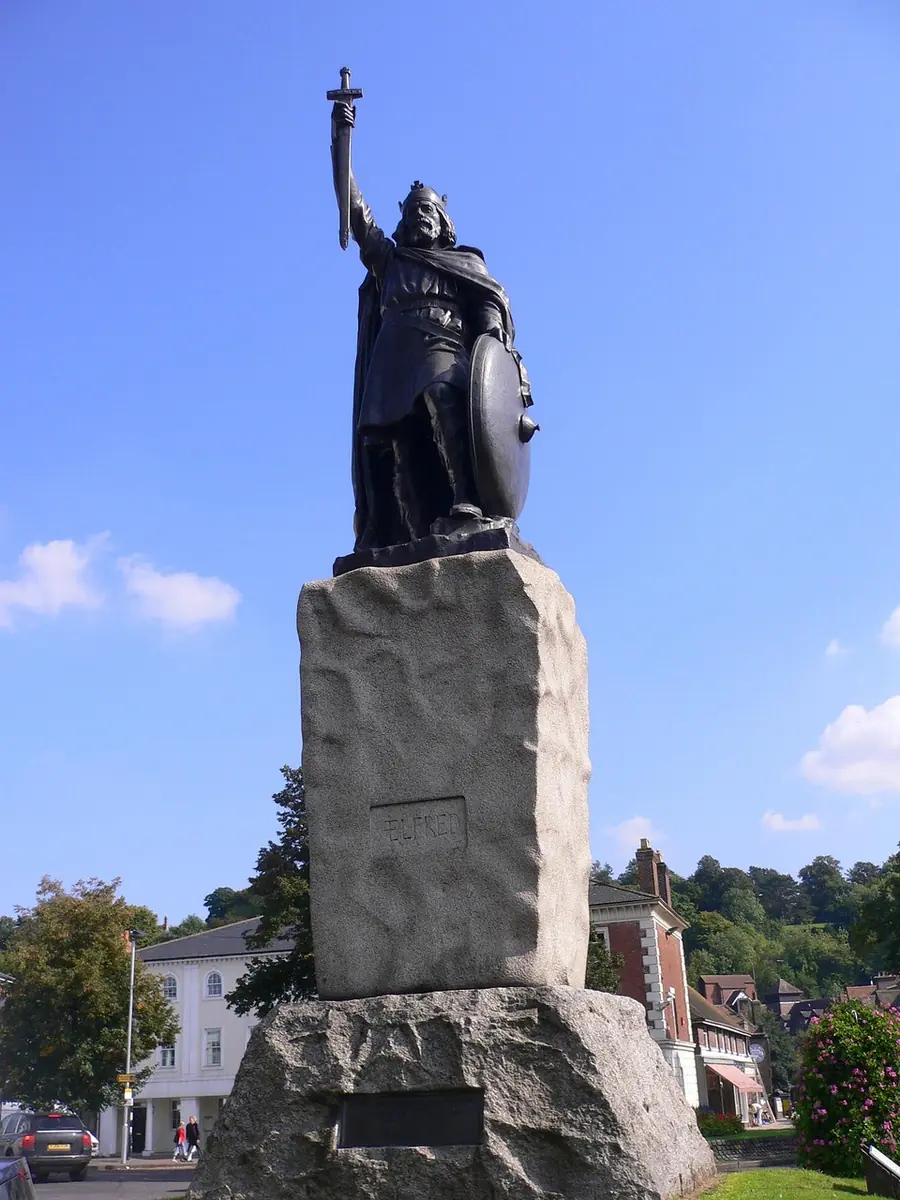
The statue of Alfred the Great stands at the eastern end of The Broadway, at the foot of Winchester’s High Street, and it is the city’s defining landmark.
It was commissioned in 1899 for the millennium of Alfred’s death, designed by the Royal Academician Hamo Thornycroft, and completed in 1901.
Alfred stands on a great block of Cornish granite, holding a sword raised by the blade so that it forms a cross, cloak over his shoulder, looking down the Broadway.
It is much bigger than people expect — this is far and away the most common reaction, and it is repeated by nearly everyone who sees it for the first time. The bronze figure alone is about 4.5 metres tall, on a plinth of similar height.
Thornycroft’s Alfred is deliberately not a warrior in armour. The sword-as-cross, the plain robe and the raised head present him as king, lawgiver and Christian scholar rather than as a battle leader, which reflects the Victorian reading of him.
Winchester was Alfred’s capital.
Alfred (r. 871–899) was King of the West Saxons and then, in the formulation used at the time, King of the Anglo-Saxons — by convention the first monarch of what became England, and the founder of the kingdom.
He is the only English monarch called “the Great”, and the reasons are: he stopped the Danish conquest of England when Wessex was the last kingdom standing; he reorganised the army and built a network of fortified burhs; he built a navy; he issued a law code; and — most unusually for any medieval king — he learned Latin in middle age and personally translated works he thought essential into English, on the grounds that literacy in the vernacular was a public good.
He laid out the street grid of Winchester that the city still uses, and he was buried here. His grave has been lost — moved from the Old Minster to the New Minster to Hyde Abbey, and dispersed at the Dissolution — and the search for his remains continues intermittently.
Abbey Gardens are immediately behind, with the River Itchen running through.
The Guildhall, the Victorian civic building, faces the statue.
The Broadway and High Street run west from here, past the Buttercross, up to the Westgate and the Great Hall — a straight walk of fifteen minutes through the whole city.
Winchester City Mill, National Trust, is fifty metres away over the bridge.
Winchester Cathedral is five minutes south.
The bus station is alongside.
Free, in the street, always visible.
Time: five minutes.
Access: it stands on a pedestrian island at street level and is fully visible from the pavement.
Photography: the light is best in the afternoon, with the statue backlit in the morning.
The bronze figure is about 4.5 metres tall on a plinth of similar height — considerably larger than most people expect.
Commissioned in 1899 for the millennium of Alfred’s death, designed by Hamo Thornycroft, completed in 1901.
It was his capital. He laid out the street grid the city still uses and he was buried here, though his grave has since been lost.
Deliberately — raised by the blade so it forms a cross, presenting him as lawgiver and Christian king rather than warrior.
No — it is a public monument in the street.