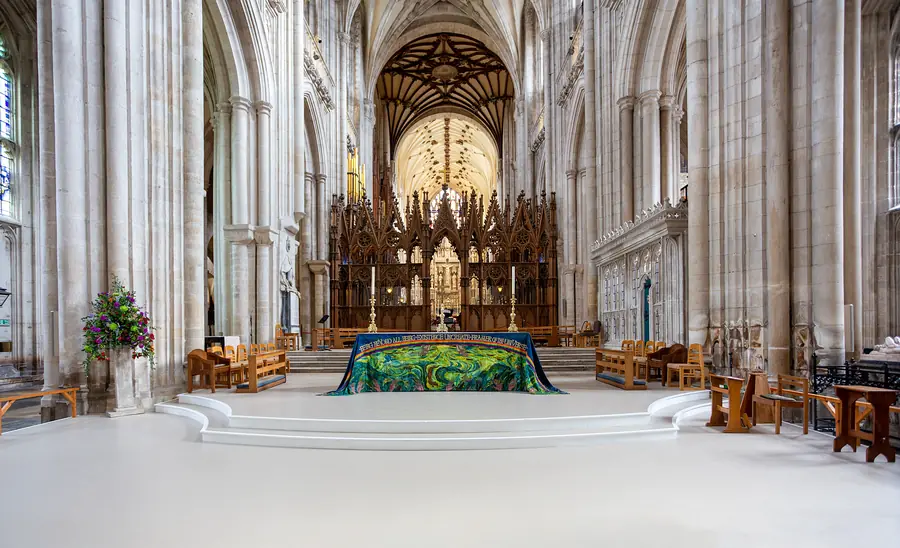
Winchester Cathedral — formally the Cathedral Church of the Holy Trinity and of Saint Peter and Saint Paul and of Saint Swithun — is among the largest churches in northern Europe, and its nave is the longest of any medieval cathedral in Europe at about 170 metres.
It is the seat of the Bishop of Winchester and the mother church of a diocese that was, for centuries, the richest in England.
Begun in 1079 on the site of the Anglo-Saxon Old Minster, whose foundations are marked out on the grass outside.
The transepts and crypt are pure Norman — massive, round-arched, austere — and are among the best-preserved Romanesque interiors in England.
The nave was transformed in the fourteenth century by Bishop William of Wykeham, who had the Norman piers recut and recased into soaring Perpendicular Gothic rather than demolishing them. Look carefully and you can see the Norman core inside the Gothic skin. It is one of the boldest pieces of architectural surgery in medieval Europe.
The retrochoir, the chantry chapels of a succession of bishops, and the Great Screen behind the high altar.
The Winchester Bible — a twelfth-century illuminated manuscript in four volumes, the largest and finest surviving English Romanesque bible, on display in the library.
The mortuary chests on the presbytery screens, holding bones traditionally identified as Anglo-Saxon and Danish kings including Cnut and Emma of Normandy. Recent scientific analysis has confirmed the remains are royal and of the right period, though jumbled.
The cathedral’s best story, and it is true.
By 1905 the building was sinking. It had been built on a raft of beech logs over waterlogged peat, the logs were failing, and the walls were cracking so badly that the south and east ends were in danger of collapse.
The ground could not be pumped dry — the water table would simply have brought the whole thing down faster. So between 1906 and 1911, a professional diver named William Walker worked in complete darkness, in water up to six metres deep, six hours a day for over five years, packing more than 25,000 bags of concrete, 115,000 concrete blocks and 900,000 bricks into the foundations by feel.
He saved the cathedral. There is a statue of him inside, and the cathedral’s survival is genuinely down to one man in a diving suit.
Jane Austen is buried in the north aisle of the nave, having died in Winchester in 1817 aged 41.
Her ledger stone, laid by her family, praises her character and her mind and does not mention that she wrote novels — her authorship was not publicly known at the time. Later brass and window memorials nearby correct the omission.
Her grave is one of the most visited spots in the building.
Admission charged, and the ticket normally converts to a year’s free return — ask.
Free guided tours run by volunteers are included and are strongly recommended; the volunteers attract consistent praise.
Tower tours climb to the roof (booked separately, and not for the claustrophobic).
The crypt contains Antony Gormley’s sculpture Sound II, standing in water — the crypt floods for much of the winter, and the figure standing in it is one of the most photographed things in the cathedral. When it is flooded the crypt can only be viewed from the entrance.
Access: the cathedral is level throughout and there is a lift to the upper level and exhibition, which visitors specifically praise.
Time: ninety minutes to two hours.
The nave is about 170 metres — the longest of any medieval cathedral in Europe.
Jane Austen, Izaak Walton, a succession of bishops, and — in the mortuary chests — bones of Anglo-Saxon and Danish kings including Cnut.
The diver who spent over five years between 1906 and 1911 underpinning the flooded foundations by hand, in darkness, and saved the building from collapse.
Yes, though when it floods in winter it can only be viewed from the entrance. Antony Gormley’s Sound II stands in the water.
Normally it converts to a year’s free return admission. Ask when you buy.