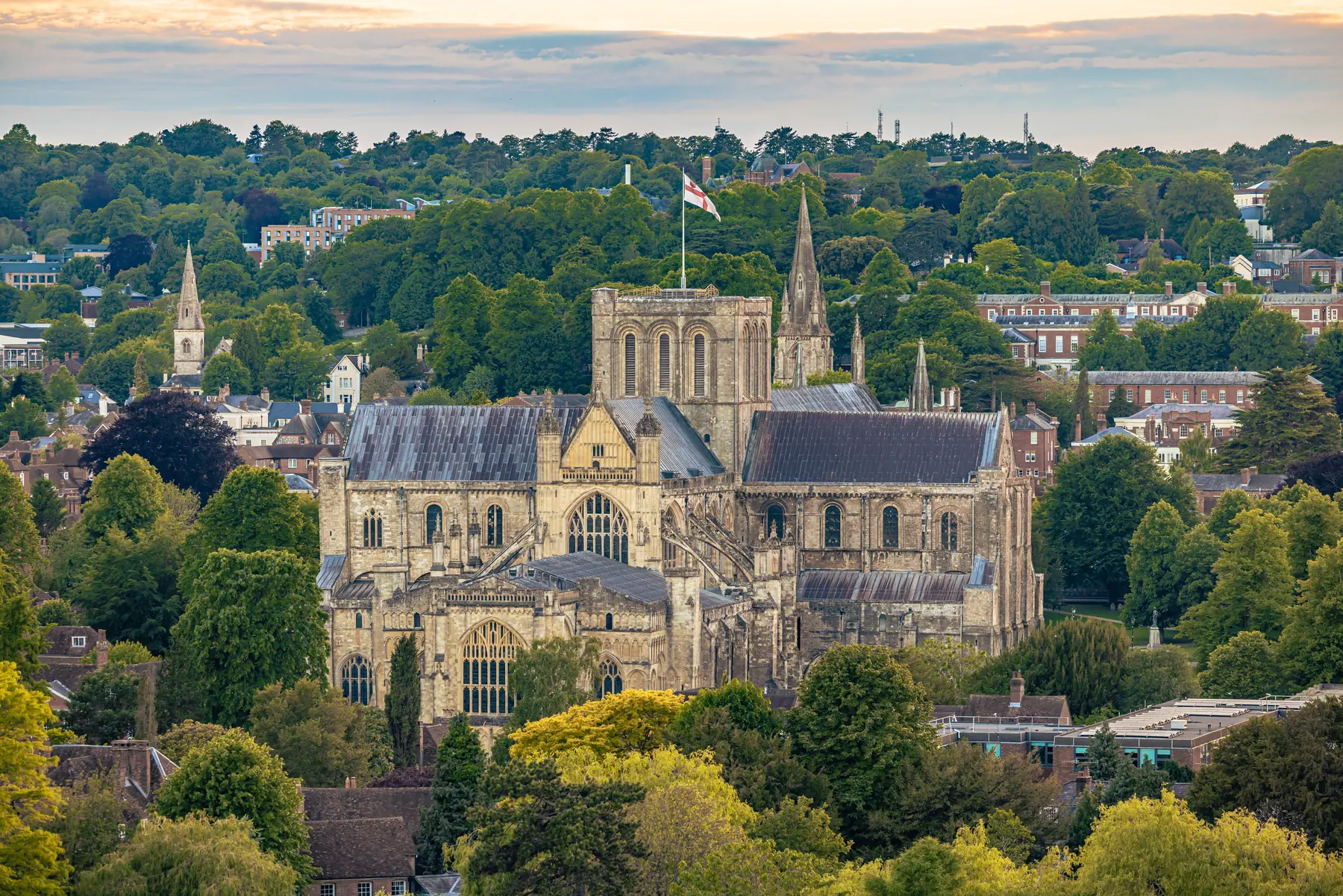
The cathedral charges, and it is worth it. Nearly everything else in Winchester is free: a free city museum, a thirteenth-century royal hall with the Round Table in it, a ruined Norman palace, an eight-hundred-year-old almshouse that still gives bread and ale to travellers, a wetland reserve four hundred metres from the High Street, and one of the best short walks in England.
In The Square beside the cathedral, and free. Three floors covering two thousand years: the Iron Age hillfort, Roman Venta Belgarum with its mosaics, the Anglo-Saxon capital of Wessex, and the medieval and Victorian city, with a reconstructed shop street.
It is the best free hour in Winchester and it explains everything else you will look at.
At the top of the High Street. The only substantial survival of Winchester Castle, destroyed on Cromwell’s orders in 1649, and one of the finest thirteenth-century halls in England. On its wall hangs the Round Table — six metres across, made around 1290 and repainted for Henry VIII.
Admission is free or by small donation depending on the arrangement — check on arrival, but it has long been among the cheapest historic buildings in England to walk into.
Beside the cathedral, the ruins of the Old Bishop’s Palace — a twelfth-century episcopal palace that was one of the greatest medieval buildings in England and where Mary I and Philip of Spain held their wedding breakfast in 1554. English Heritage, free, and usually empty.
At the bottom of the Broadway, commissioned in 1899 for the millennium of Alfred’s death: a huge bronze of the king with his sword raised as a cross. It is the image of Winchester and it costs nothing to stand under. See our King Alfred page.
The fifteenth-century Buttercross stands in the middle of a pedestrianised High Street that has been the city’s main street since Roman times. The Westgate at the top is one of two surviving medieval city gates; King’s Gate at the bottom of the close has a small church built above the arch, which is a rare survival.
The city walls run along the eastern side by the river.
The cathedral charges for entry, but the close and the Inner Close are open and free, the exterior is magnificent, and attending a service — including evensong — is free. The cathedral choir is very good and evensong is the building doing what it was built for.
The best free thing in Winchester. From the cathedral, through the close and past Winchester College, out onto the water meadows and along the Itchen for two kilometres to the Hospital of St Cross.
St Cross is a medieval almshouse founded in 1136 and the oldest charitable institution in England still functioning. Entry to the buildings charges, but the walk is free — and so is the Wayfarer’s Dole, a horn of ale and a morsel of bread given to any traveller who asks at the porter’s lodge, as it has been for eight centuries.
John Keats walked this route in the autumn of 1819 and wrote To Autumn afterwards.
St Giles Hill, ten minutes from the High Street, is a public park on a chalk spur with a viewpoint looking straight down onto the cathedral. Free and quick.
St Catherine’s Hill, two kilometres south-east, is a chalk down with an Iron Age hillfort and a mizmaze — a turf labyrinth cut into the ground near the summit, one of very few surviving in England. Free, steep, and the classic view of the city.
Winnall Moors, four hundred metres from the High Street, is a 64-hectare wetland reserve with boardwalks through reedbed and carr woodland along the Itchen. Kingfishers, water voles and otters. Free.
Old Winchester Hill, eighteen kilometres south-east in the Meon valley, is a national nature reserve on a chalk hill with a hillfort and a barrow cemetery, exceptional for orchids and butterflies. Free.
Farley Mount Country Park, eight kilometres west, is downland and beech wood with a pyramid monument to a racehorse. Free.
Stockbridge Down and the Test valley, twenty kilometres west, are National Trust downland.
Winchester’s farmers’ market, held twice a month on the High Street, is among the largest in the country and free to walk round. The Hat Fair in July is a free street theatre festival — the oldest in Britain — that takes over the whole city. The Christmas market in the cathedral close is a paid ticket at peak times but free at others, and the Winchester Festival and a run of city events fill the rest of the calendar.
The cathedral, and parking. There are park and ride sites on the edges of the city which are cheap and frequent, and the station is a ten-minute walk from the High Street with four trains an hour from London Waterloo — so a car-free day here is easy.
Start at the City Museum, which is free and sets everything up. Walk the High Street past the Buttercross to the Great Hall and the Round Table, then back down to the King Alfred statue. Look into the cathedral close and Wolvesey Castle. Lunch on the High Street or in the market.
In the afternoon, take the Keats walk through the water meadows to St Cross, ask for the Wayfarer’s Dole, and come back over St Catherine’s Hill for the view. Finish at evensong in the cathedral, which is free and is the best hour of the day.
A Roman city, an Anglo-Saxon capital, a Norman palace, a medieval almshouse and a chalk hillfort, for nothing.
The first free day covered the city. The second should go up onto the chalk. Walk out to St Catherine’s Hill for the hillfort and the mizmaze, then follow the South Downs Way east over Cheesefoot Head — a natural amphitheatre where Eisenhower addressed the troops before D-Day — towards Beacon Hill and the Meon valley. Bus back.
Or go north up the Itchen Way through Kings Worthy, Itchen Abbas and Ovington towards Alresford — chalk stream walking through what is probably the most-fished valley in England, with pubs at intervals.
Both are free, both are quiet, and both are the reason the South Downs National Park starts here.
Worth checking. Winchester City Mill and Stockbridge Down are National Trust; Wolvesey Castle and Bishop’s Waltham Palace are English Heritage — though Wolvesey is free to everyone anyway. Neither membership is needed for anything on this page, but for a week in Hampshire both go further than you would expect.
Yes, and it is the best introduction to the city.
Admission has long been free or by small donation — check on arrival. The Round Table is inside it.
No, there is an admission charge for visitors, but the close is open and attending a service including evensong is free.
Bread and ale, given to any traveller who asks at the Hospital of St Cross. It has been offered since the twelfth century.
A turf labyrinth cut into the ground near the summit of St Catherine’s Hill — one of very few surviving in England, and free to walk.