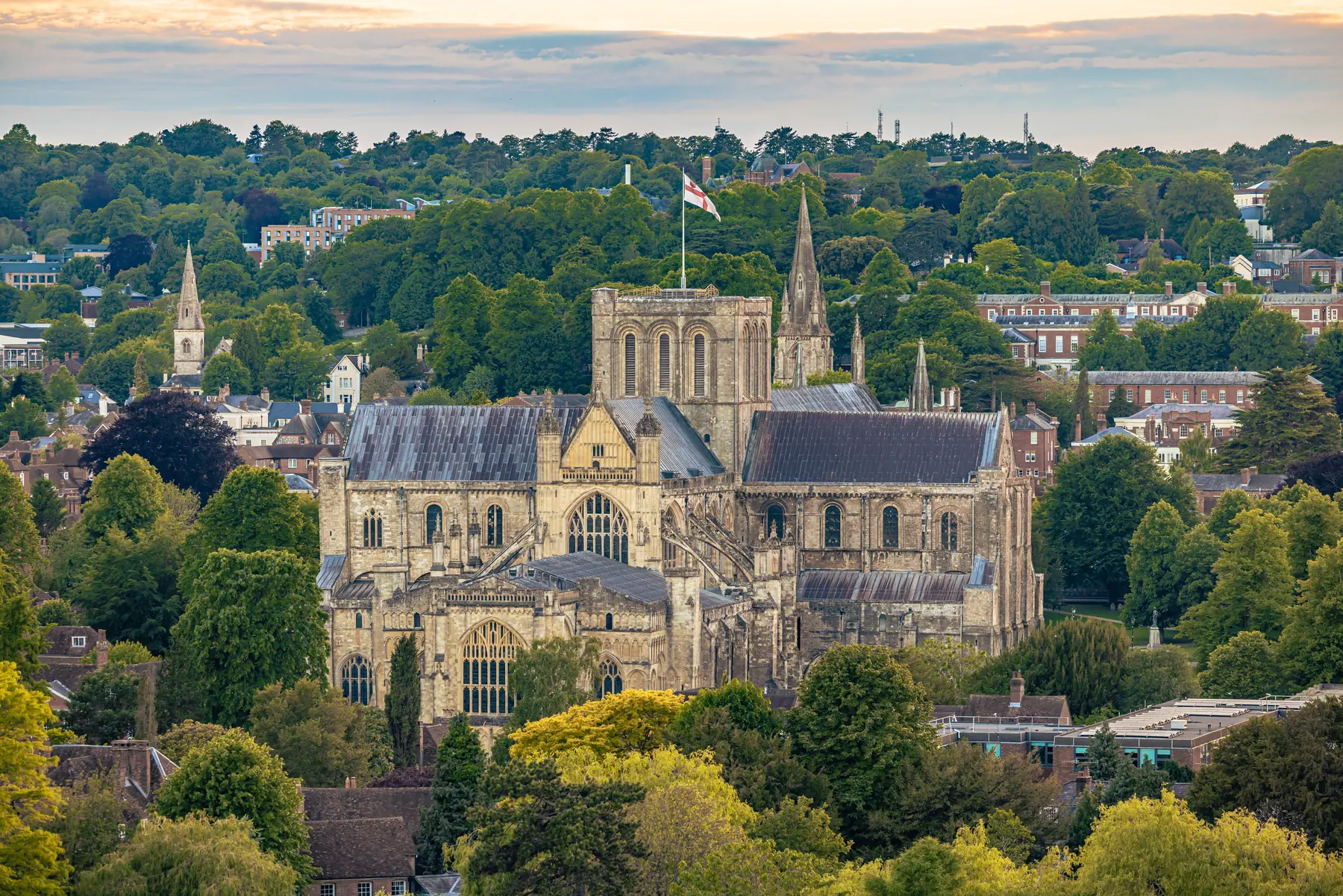
Winchester Cathedral is one of the largest and most historically important churches in Europe, and it very nearly fell down in 1906. Both of those facts are worth knowing before you go in, because between them they explain most of what you will look at.
It is also unusually rich in things that are not architecture: the finest Romanesque illuminated manuscript in England, the best medieval floor tiles in the country, Jane Austen’s grave, and a crypt that floods every winter with a Gormley sculpture standing in the water.
A cathedral has stood on this site since the seventh century, when Winchester was the capital of Wessex. The Old Minster — the Anglo-Saxon cathedral, where Alfred the Great and his successors were crowned and buried — stood immediately north of the present building, and its outline is marked in brick on the grass.
The Normans began the present cathedral in 1079, and the transepts are still theirs — massive, plain, round-arched, and among the finest Norman work in England.
The nave was remodelled in the fourteenth century by Bishop William of Wykeham, who cased the Norman piers in Perpendicular stonework rather than demolishing them. The result is one of the longest naves in Europe and, walking in from the west door, one of the great architectural views in Britain.
The length is the thing. Stand at the west end and look down it. The west window above you is a jigsaw of medieval glass reassembled after Parliamentary soldiers smashed it in 1642 — the townspeople gathered the fragments, and it was put back without any attempt to reconstruct the pictures. It is abstract by accident and rather beautiful.
A twelfth-century illuminated manuscript in four volumes, commissioned around 1160 and never entirely finished, and among the greatest works of Romanesque book painting anywhere. It is displayed in the cathedral’s exhibition space — check where and when, as the display arrangements change.
Behind the high altar, the retrochoir has the largest area of medieval floor tiles in England, laid in the thirteenth century and still in place. You walk on them.
On the presbytery screens sit painted wooden chests said to hold the bones of Anglo-Saxon and Danish kings, including Cnut and Emma of Normandy, moved here from the Old Minster and thoroughly jumbled by Parliamentary soldiers who used the bones to break the windows. Recent scientific study has been trying to sort them out.
In the north aisle of the nave, marked by a black ledger stone that famously does not mention that she wrote anything — she died in Winchester in 1817 and her novels were published anonymously. A brass plaque and a window were added later by her family and admirers.
Norman, low, and it floods. The water table here is very high, and through the winter the crypt fills. Standing in it is Sound II, an Antony Gormley figure looking down at its cupped hands, up to its knees in water for several months of the year. It is one of the most memorable things in any English cathedral.
Access is restricted when the water is high, but you can see it.
A series of enclosed tomb-chapels for medieval bishops, including William of Wykeham’s — the man who remodelled the nave and founded Winchester College and New College, Oxford.
A small chapel with twelfth-century wall paintings, rediscovered under later plaster, which are among the finest surviving Romanesque paintings in England.
The story visitors remember. By 1900 the cathedral’s east end was sinking: the medieval builders had founded it on a raft of beech logs over peat and running water, and it was going.
Between 1906 and 1911 a professional diver named William Walker worked six hours a day in complete darkness in the flooded foundations, removing peat and packing bags of concrete underneath the walls by feel. He is generally credited with saving the building single-handed, and there is a statue of him in the cathedral.
It is a good story and it is essentially true.
Tickets. There is an admission charge for visitors, valid for repeat entry over a period in most arrangements — worth checking, since it turns one ticket into several visits.
Time. Two hours minimum; three to do it properly. Longer with the tower tour.
Tower tours climb to the roof and the tower for a view over the city; they are booked separately, have age and fitness requirements, and do not run in bad weather.
Guided tours by the cathedral’s own volunteer guides are included and are very good.
Services are free to attend. Evensong, sung most days in term, is the best hour in Winchester and requires no ticket.
The close and the outside are free and open, as is the outline of the Old Minster on the grass.
The cathedral sits in the largest close in England, and everything else is a few minutes away: Winchester College, founded in 1382 and the oldest continuously running school in the country; Wolvesey Castle, the ruined bishop’s palace, free; the City Museum, free; and the water meadows walk to St Cross.
Our free things guide covers the rest.
Early morning, as soon as the visitor route opens, for the nave with nobody in it and the light coming through the east end.
Evensong, sung most days in term, is free, forty minutes and the best thing in the building. The visitor route closes while it happens, which is worth knowing if you were mid-tour.
Winter for the flooded crypt with Gormley’s figure standing in the water, which is the image most people take away, and for the Christmas market in the close.
Avoid the middle of a summer Saturday, when the coach parties and the day trippers from London arrive together.
The cathedral sits in the largest close in England, and the buildings round it are worth an hour on their own. The Deanery incorporates the thirteenth-century prior’s lodging; the Pilgrims’ Hall has the earliest surviving hammerbeam roof in England, from around 1310; and Cheyney Court, the timber-framed building at the close’s south-east corner, is one of the most photographed houses in Hampshire.
The Kingsgate, the medieval city gate at the bottom of the close, has the tiny church of St Swithun-upon-Kingsgate built above the arch — a rare survival, free, and reached by a narrow staircase.
Beyond it, Winchester College and the water meadows begin, which makes the close a natural starting point for the Keats walk.
Two hours minimum, three to see it properly, more with a tower tour.
No, there is an admission charge for visitors — though tickets often allow repeat entry, and attending a service including evensong is free.
In the north aisle of the nave. Her ledger stone does not mention her novels.
Yes, most winters. Antony Gormley’s figure Sound II stands in the water, which is the image most visitors take away.
The diver who worked in the flooded foundations from 1906 to 1911, packing concrete under the walls by feel, and who is credited with saving the cathedral from collapse.