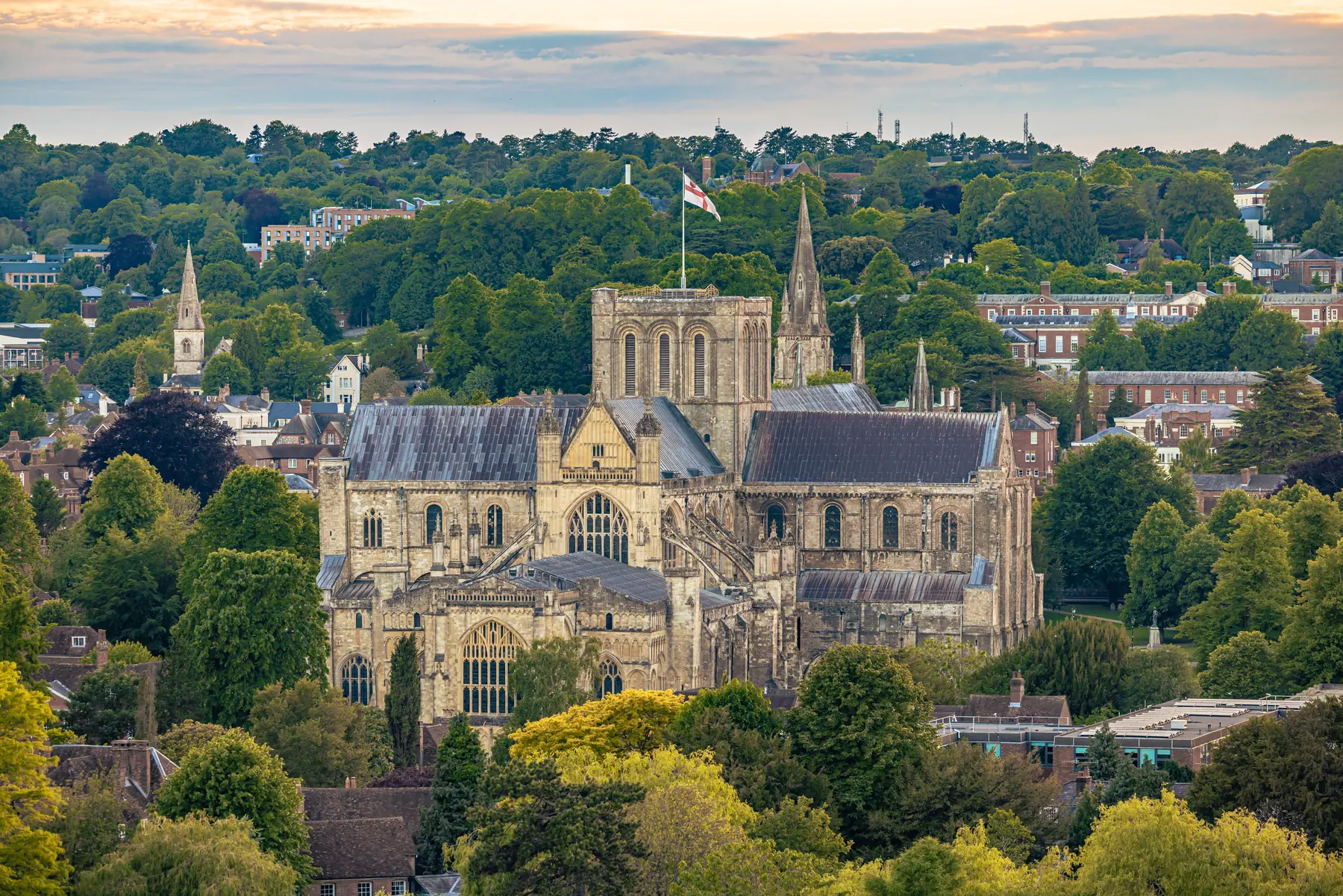
Winchester is a good wet-weather city, and the reason is that it has been an important place for two thousand years and has accumulated the buildings to match. There is one of the great cathedrals of Europe, a thirteenth-century royal hall with the Round Table in it, a city museum, three military museums in one barracks, a science centre with a planetarium, and a compact medieval centre in which nothing is more than ten minutes from anything else.
Hampshire is also one of the drier counties in England, so the odds are better than in most of the country.
Three hours if you do it properly, and it is entirely indoors.
Winchester Cathedral is among the longest cathedrals in Europe, with a Norman crypt, a Norman transept, a Perpendicular nave of extraordinary length, medieval wall paintings, the finest medieval floor tiles in England, and the Winchester Bible — a twelfth-century illuminated manuscript that is among the greatest surviving works of Romanesque book painting.
Jane Austen is buried in the north aisle. The crypt floods in winter, and Antony Gormley’s standing figure Sound II stands in the water, which is one of the more remarkable sights in any English cathedral.
And there is the story of William Walker, the diver who worked in the flooded foundations for six years from 1906, single-handedly packing bags of concrete under the walls to stop the whole east end collapsing into the peat.
Our cathedral guide covers it in full.
At the top of the High Street, the only substantial survival of Winchester Castle, which Cromwell ordered destroyed in 1649. The hall is thirteenth-century and one of the best of its date in England, and on its wall hangs the Round Table — six metres across, made around 1290 and repainted for Henry VIII in 1516.
Free or nearly so, indoors, and half an hour well spent.
In The Square, beside the cathedral. Three floors covering the city from the Iron Age hillfort through Roman Venta Belgarum, the Anglo-Saxon capital and the medieval city, with Roman mosaics and a reconstructed Victorian shop street. Free.
In the medieval city gate at the top of the High Street, with a room above the arch, a painted Tudor ceiling, weights and measures, and a view down the street. Small, cheap and unusual.
Peninsula Barracks on Romsey Road holds three or four regimental museums in one complex — the Gurkha Museum, the Rifles Museum, the Royal Hampshire Regiment Museum and the Royal Green Jackets Museum with its enormous Waterloo diorama, a model of the battlefield with over twenty thousand figures.
They are individually small and collectively a full afternoon, and they are better than the phrase “regimental museum” suggests.
Three kilometres east at Morn Hill. Over a hundred hands-on exhibits and the largest standalone planetarium in the UK, running shows through the day. Half a day, entirely indoors, and the best wet-weather option for families.
Winchester’s High Street is pedestrianised for much of its length and lined with shops, and the Brooks Centre covers the indoor shopping. There is a market on the High Street several days a week and a farmers’ market twice a month — one of the largest in the country.
The city has an unusually good bookshop and independent retail scene for its size, and the Theatre Royal on Jewry Street runs a full programme.
Wolvesey Castle — the ruined Norman bishop’s palace beside the cathedral — is open and free but roofless.
Marwell Zoo works in rain up to a point: the animals are outdoors anyway, there is a large tropical house, and the indoor play areas cover the rest.
The Watercress Line at Alresford runs steam trains through the Hampshire countryside, and sitting in a warm carriage watching rain on the water meadows is a legitimate wet-day activity.
Bishop’s Waltham Palace, fourteen kilometres south, is a ruined episcopal palace with a visitor centre.
Southampton, twenty-three kilometres south and fifteen minutes by train, has the SeaCity Museum with its Titanic galleries, the Tudor House and a city’s worth of covered shopping.
Portsmouth, forty minutes, has the Historic Dockyard — the Mary Rose museum, HMS Victory and HMS Warrior — which is most of a day indoors.
Salisbury, an hour west, has another great cathedral and one of the four surviving copies of Magna Carta.
London is an hour by train, which makes a wet-day escape to the national museums entirely practical.
Winnall Moors has boardwalks and tree cover and is four hundred metres from the High Street.
The water meadows to St Cross are level and short, though they flood in winter, which is what water meadows are for.
The cathedral close and the walk round the city walls take half an hour and are largely sheltered by buildings.
Avoid St Catherine’s Hill in heavy rain — the chalk steps are slippery.
Trains run four times an hour to London Waterloo in about an hour, and to Southampton in fifteen minutes, which makes escaping easy.
Park and ride on the edges of the city is the sensible option in any weather.
Cathedral opening varies with services; evensong is free to attend and is the building at its best.
Seasonal. Most of Winchester’s attractions are year-round; the Watercress Line and Marwell reduce hours in winter.
The shape that works: the cathedral from opening until early afternoon, which is three hours indoors in one of the great buildings of Europe. Lunch in the close or on the High Street. Then the City Museum, free and twenty minutes away, or the Great Hall for the Round Table. Finish at evensong, which is free, forty minutes, and the cathedral doing what it was built for.
If you have children, swap the afternoon for the Science Centre three kilometres east.
If the rain has set in for the week, the trains make it easy: Southampton in fifteen minutes for SeaCity, Portsmouth in forty for the dockyard, London in an hour for anything.
Winchester sits in a chalk valley in one of the drier and sunnier parts of England — southern Hampshire records notably more sunshine and less rain than the national average, sheltered from the worst of the Atlantic weather by the West Country.
The practical consequence is that full wet days here are less common than the planning suggests, and the standard pattern is a wet morning clearing by lunchtime. Look at the radar, and keep the water meadows walk in reserve for when it does.
Winchester’s High Street is pedestrianised for most of its length and lined with shops, with the Brooks Centre covering the indoor retail. The lanes off it — Parchment Street, Jewry Street, the Square — carry the independents, the bookshops and a strong café culture.
The cathedral close is sheltered by its own buildings and the Refectory there is a good place to sit without a ticket. The Theatre Royal on Jewry Street has a bar and a full programme. And the city’s pubs — the Wykeham Arms above all — are old, small and entirely comfortable with people coming in out of the weather.
The cathedral for three hours, the Great Hall and the Round Table, the free City Museum, and the military museums at Peninsula Barracks.
Yes, and it covers the city from the Iron Age through Roman Venta Belgarum to the medieval capital.
The Winchester Science Centre and Planetarium, three kilometres east at Morn Hill.
It floods in winter and access is restricted then — but the flooded crypt with Gormley’s figure standing in the water is worth seeing through the grille.
Southampton in fifteen minutes by train; Portsmouth in about forty minutes.