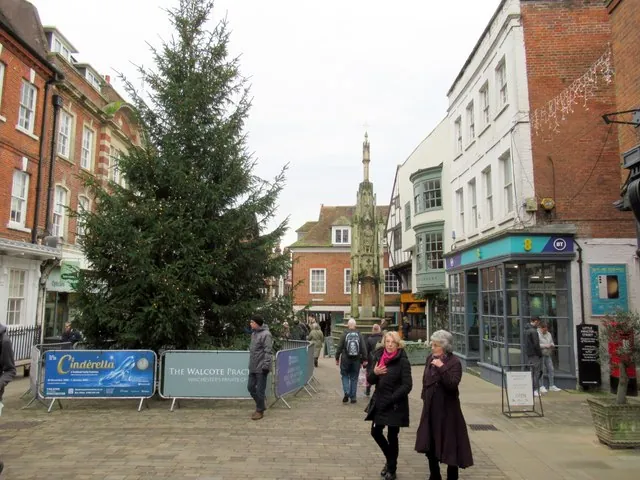
The Buttercross — also called the High Cross or the City Cross — stands in the middle of Winchester’s High Street, and it dates from the early fifteenth century.
It has been standing on this spot for over 600 years.
A market cross: a tall, tiered Gothic monument of Purbeck and Caen stone, roughly 13 metres high, with a stepped base, niches holding statues, and a pinnacled shaft.
Market crosses stood at the centre of medieval market places across England and served several purposes — a focus for the market, a place for proclamations, a reminder that trade should be conducted honestly, and a shelter.
The name Buttercross comes from its use: butter, milk and dairy produce were sold from the steps, which are shaded and were the coolest spot in the market place.
Most of the statues in the niches are Victorian replacements, added during a restoration by William Butterfield in 1865. One figure — commonly identified as St John the Evangelist — is thought to be original medieval work.
The Buttercross’s best story is from 1770.
The corporation of Winchester sold the cross to a Mr Thomas Dummer, who intended to remove it and re-erect it as a garden ornament at his estate at Cranbury Park.
When the workmen arrived to dismantle it, the townspeople rioted and drove them off. The sale was abandoned, the cross stayed, and Dummer had a lath-and-plaster replica built at Cranbury instead, which has long since fallen down.
It is one of the earliest recorded instances of a British public successfully preventing the removal of a historic monument, and it is why the thing is still in the High Street.
It is a monument in the street. There is no ticket, no gate and no opening time — a point that has to be made because people search for tickets.
You look at it, walk round it, and read the information nearby. Five minutes.
One warning: the Buttercross is periodically covered in scaffolding for conservation work, which has disappointed visitors who came specifically to see it. There is no way to check this in advance beyond local news, and it is a fair reason to treat it as something you look at while walking the High Street rather than a destination.
The steps are a traditional meeting place and are usually occupied by people sitting on them, which is exactly what they are for.
The High Street is Winchester’s spine, running from the Westgate at the top to King Alfred’s statue at the bottom, and it is one of the best small-city streets in England — largely pedestrianised, with a mix of medieval, Georgian and Victorian frontages.
The Great Hall and the Westgate Museum are five minutes up.
Winchester Cathedral is three minutes down and to the side.
Abbey Gardens and the City Mill are at the bottom.
God Begot House, a fifteenth-century timber-framed building, is opposite the cross.
Free, always accessible, no tickets.
Time: five minutes.
Location: Winchester High Street, roughly halfway along.
Access: it stands in a pedestrianised street at ground level.
No — it is a monument standing in a public street.
Early fifteenth century, so over 600 years on this spot.
Butter and dairy produce were sold from its shaded steps in the market.
The corporation sold it to a landowner who intended to move it to his garden. The townspeople rioted, the workmen were driven off, and the sale was abandoned.
Usually, but it is periodically covered in scaffolding for conservation work.