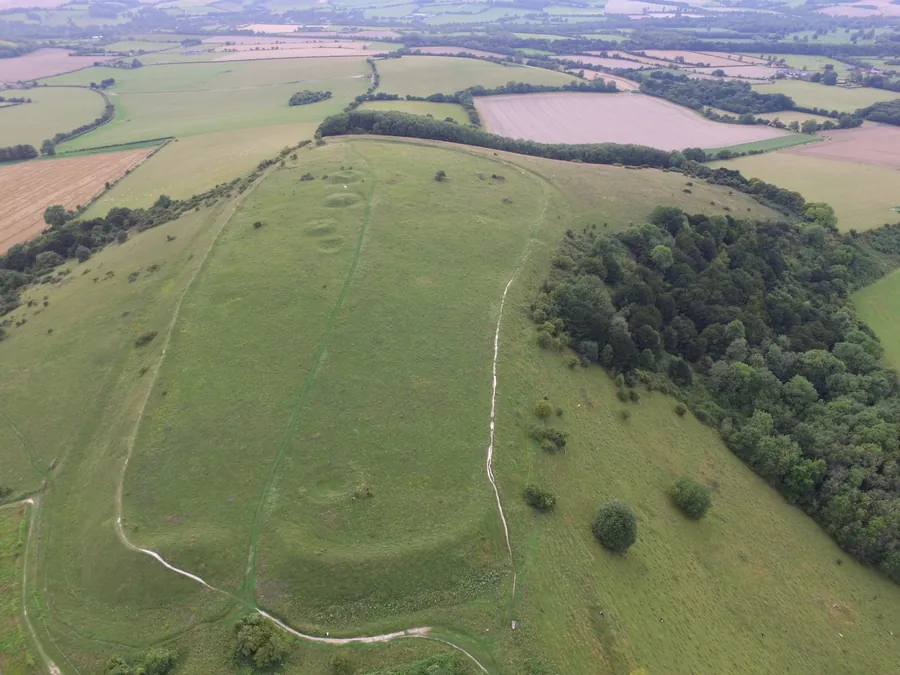
Old Winchester Hill is a 66-hectare chalk hill near Warnford in the South Downs National Park, eighteen kilometres east of Winchester.
It is a national nature reserve, a Site of Special Scientific Interest, a Grade I Nature Conservation Review site, and part of it is a scheduled monument. Few places in England carry that many designations at once, and it earns all of them.
Despite the name, it has no direct connection with Winchester — the origin is disputed, and the hill is well outside the city’s territory.
The summit carries an Iron Age hillfort of about the sixth to third century BC: a single rampart and ditch enclosing roughly 5.5 hectares, with entrances at either end.
Within and around it are Bronze Age round barrows, several of them prominent on the skyline and some pre-dating the fort by a thousand years or more — burial monuments on a ridge that people were evidently using long before anyone fortified it.
The ramparts are grassed over and walkable, and the interior is open grass.
The hill is one of the finest surviving areas of unimproved chalk grassland in southern England, which is why the nature designations are so heavy.
Orchids — several species, including the round-headed rampion which is the emblem of the South Downs, and in good years a substantial display.
Butterflies — a superb list including chalkhill blue, adonis blue, Duke of Burgundy, silver-spotted skipper and marbled white. This is one of the best butterfly sites in Hampshire, and June to August is the season.
Juniper scrub, which is nationally scarce.
Yew woodland on the slopes.
The grassland is grazed to maintain it, so livestock may be present.
This is what most people come for.
From the ramparts the view runs across the Meon Valley and miles of South Downs countryside, and on a clear day south to the Solent and the Isle of Wight.
It is one of the great viewpoints of southern England, and it is superb at sunset — a specific and repeated recommendation from people who use it.
From the free car park on the ridge, an easy path along the chalk ridge leads to the fort — a walk of perhaps ten to fifteen minutes on level ground, which is unusual for a hillfort and makes this one of the most accessible in the country.
Longer routes drop into the valley and connect with the South Downs Way, which passes close by, and with the Meon Valley Trail on the old railway line below.
A caution: part of the hill is a former military firing range and unexploded ordnance has been found. Stay on the marked paths. The signs are clear and should be obeyed.
Free, open at all times.
Parking: a free car park on the ridge, which visitors describe as handy and which fills on fine weekends.
Facilities: none.
Time: an hour to ninety minutes.
Access: the path from the car park to the fort is level and reasonably surfaced — good for a hillfort. The slopes are not.
Dogs: under control near livestock and ground-nesting birds.
Getting there: near Warnford, off the A32 in the Meon Valley, about twenty-five minutes from Winchester by road.
No, despite the name — it is eighteen kilometres east in the Meon Valley, and the origin of the name is disputed.
Iron Age, roughly the sixth to third century BC, with Bronze Age burial barrows on the same ridge that are considerably older.
Yes, on a clear day, along with the Solent, across the South Downs to the south.
No — the path from the free car park along the ridge to the fort is level and easy, unusually so for a hillfort.
Yes — part of the hill was a military firing range and unexploded ordnance has been found. Stay on the marked paths.