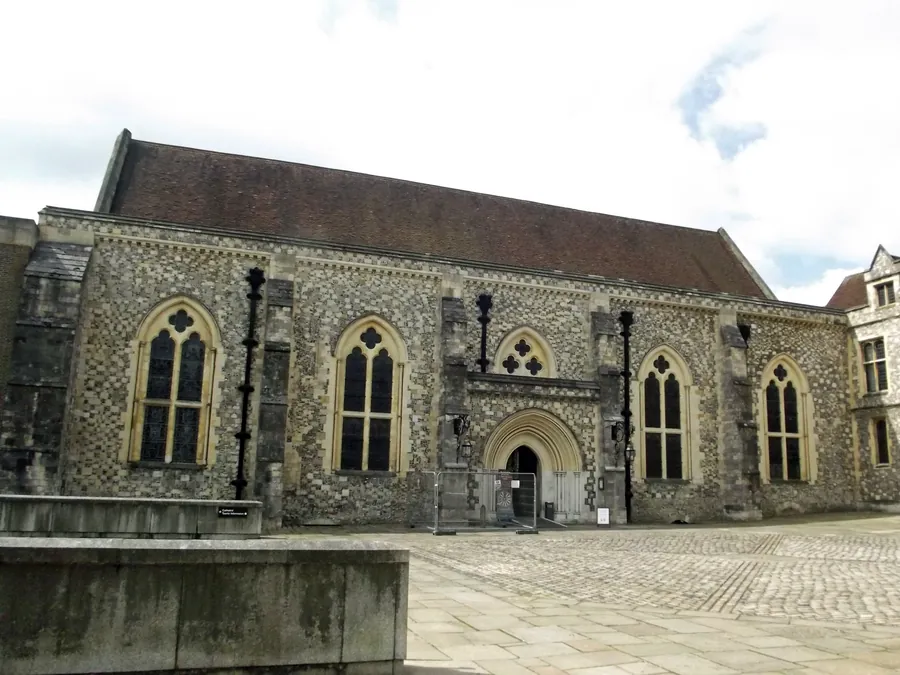
The Great Hall on Castle Avenue is the only surviving building of Winchester Castle, and it is one of the finest medieval halls in England.
It was built between 1222 and 1235 for Henry III, who was born in the castle, and it is a double-aisled hall with Purbeck marble columns, tall Gothic windows and a superb timber roof.
Everything else — the keep, the royal apartments, the curtain walls — is gone, demolished after the Civil War and built over.
Hanging on the east wall is a great oak table top, 5.5 metres across and weighing over a ton, painted in green and white segments with a king at the top and the names of twenty-four knights around the rim.
It is not King Arthur’s Round Table, and nobody serious has claimed so since the sixteenth century.
What it actually is is considerably more interesting.
Tree-ring dating and radiocarbon put its construction at around 1250–1280, most likely made for Edward I — a king obsessed with Arthurian chivalry — for a Round Table tournament, a fashionable form of aristocratic entertainment in which knights took the names of Arthur’s court and fought accordingly.
The painting is much later. It was decorated on the orders of Henry VIII, probably for the state visit of the Holy Roman Emperor Charles V in 1522. The king at the top of the table is Arthur — with Henry VIII’s own face, complete with Tudor rose beneath, which is about as subtle a piece of political propaganda as Henry ever managed.
It has hung on this wall since about 1348.
Queen Eleanor’s Garden, a small reconstruction of a thirteenth-century medieval garden, based on documentary evidence — a fountain, a turf seat, herbs and a tunnel arbour. It is small and charming.
The historic wall on the way out towards the toilets carries detailed interpretation boards, which visitors specifically mention as good.
Stained glass by the Victorian and modern periods, including a window of names of Hampshire MPs.
The bronze statue of Queen Victoria by Alfred Gilbert.
The hall was used as a courtroom for six centuries — Sir Walter Raleigh was tried and condemned to death here in 1603, and the Bloody Assizes of Judge Jeffreys sat here after Monmouth’s rebellion in 1685.
It is small. Twenty to thirty minutes covers it, and visitors who arrive expecting a castle are briefly disappointed until they see the table.
The Explorer ticket is the tip everybody passes on: a combined ticket covering the Great Hall and two local museums — usually the Westgate and the City Museum or Military Museums — at considerably better value than paying separately. Ask at the desk.
Admission charged, modest; look for the Explorer ticket.
Time: twenty to forty minutes with the garden.
Location: Castle Avenue, at the top of the High Street, five minutes from the centre.
Facilities: shop, toilets.
Access: the hall is level and accessible.
The Westgate Museum, a medieval city gate with a museum in it, at the top of the High Street.
The Military Museums in Peninsula Barracks, next door — six regimental museums on one site.
Winchester Cathedral is ten minutes down the High Street.
The Buttercross and the High Street are between them.
No. It was made around 1250–1280, probably for Edward I’s Arthurian tournaments, and painted for Henry VIII around 1522 — with Henry’s own face on the figure of Arthur.
5.5 metres across and over a ton in weight, hanging on the wall since about 1348.
Nothing but this hall. The rest was demolished after the Civil War.
Yes — the Explorer ticket covers the Great Hall and two local museums, and is much better value.
Twenty to forty minutes, including Queen Eleanor’s Garden.