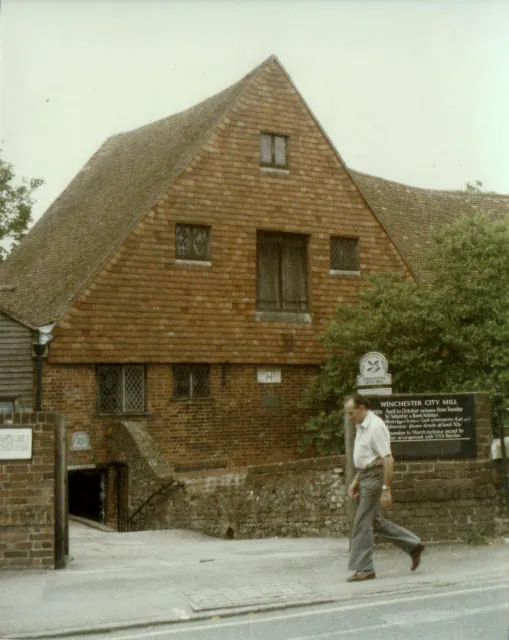
Winchester City Mill straddles the River Itchen at the bottom of the High Street, fifty metres from the statue of King Alfred, and it is a working watermill producing flour.
There has been a mill on this site since at least the Domesday Book of 1086, and probably since the Anglo-Saxon period. The present building dates from 1743, rebuilt on the medieval foundations, and it is owned by the National Trust.
The mill grinds flour on milling days, using water power from the Itchen, and you can watch the whole process: the wheel turning, the gearing, the stones, and the flour coming off.
The flour is sold in the shop, and buying a bag of it milled that morning under the floor you are standing on is the point of the visit.
Milling days are advertised — typically at weekends and more often in season. Check before travelling if seeing the mill in operation is what you want.
The restoration was carried out by volunteers, and the machinery was returned to working order in 2004 after a long period out of use.
The mill race runs beneath the building and you can go down to it, standing right over the rushing water, which children find far more compelling than any display.
An island in the river beneath the mill is accessible, with the water running on both sides.
The wheel, the gearing and the stones are all visible and explained.
The building itself is a handsome Georgian structure sitting directly on the water in the middle of a city, which is a rare thing in England.
The mill has cameras trained on the river and the otter holt, and otters are regularly recorded on the Itchen here — in the centre of a cathedral city.
The footage plays in the mill, and there is a genuine chance of seeing an otter live on the camera. Kingfishers, water voles, brown trout and grayling are also on the river.
The Itchen is one of the great chalk streams — clear, alkaline, spring-fed, and one of a very small number of such rivers in the world, most of which are in southern England. That is why the wildlife is what it is.
It is small. Forty-five minutes to an hour covers it, and visitors should come expecting a working mill rather than a museum.
Volunteers run it and are, as at most Trust properties of this kind, the best thing about it — they will explain the machinery in as much detail as you want.
Children do well here: the water, the noise, the machinery and the otter cameras.
Admission charged; free to National Trust members.
Time: forty-five minutes to an hour.
Location: Bridge Street, at the bottom of the High Street by the Alfred statue — the most central National Trust property in England.
Facilities: shop selling the mill’s own flour; toilets. No café — the city is immediately outside.
Access: the building is a working eighteenth-century mill with stairs and low headroom; the ground floor is more manageable. Check ahead.
Season: open most of the year with reduced winter hours; milling days vary.
King Alfred’s statue is fifty metres away.
Abbey Gardens are immediately alongside.
The Weirs — a riverside walk along the Itchen beneath the old city wall — starts here and runs south towards Wolvesey Castle and the Hospital of St Cross.
Winnall Moors nature reserve is five minutes upstream.
Winchester Cathedral is five minutes south.
Yes — it works on advertised milling days and the flour is sold in the shop. Check the schedule before travelling.
There has been a mill here since at least 1086; the present building dates from 1743.
There are cameras on the river and the holt, and otters are regularly recorded. Live sightings on the camera do happen.
Yes.
Forty-five minutes to an hour. It is small.