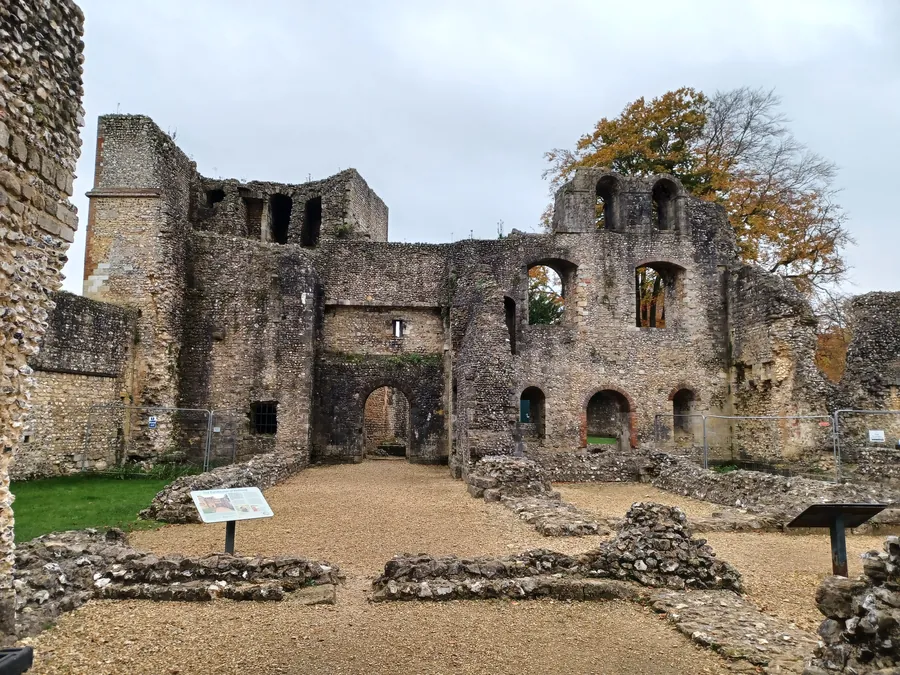
Wolvesey Castle stands on College Street, in the south-east corner of Winchester inside the old city walls, and it was the chief residence of the Bishops of Winchester for five centuries.
That matters more than it sounds. Winchester was the wealthiest diocese in medieval England — richer than most earldoms, and its bishops were routinely chancellors, treasurers and effective heads of government. Wolvesey was not a country palace; it was one of the principal centres of power in the kingdom.
The ruins are extensive, and they reflect that.
Henry of Blois, bishop from 1129 to 1171 — brother of King Stephen, and one of the most powerful men in twelfth-century Europe — built most of what survives.
The West Hall and East Hall, two great halls facing each other across a courtyard, with a keep and a curtain wall added during the civil war of Stephen’s reign, when Henry of Blois fortified the palace against his brother’s rival Matilda.
The chapel, the kitchens and the domestic ranges.
Queen Mary I and Philip of Spain held their wedding breakfast here in 1554, after marrying in the cathedral.
The palace was slighted after the Civil War and largely demolished in the 1680s, when Bishop Morley built the present Wolvesey Palace next door — a Baroque building still in use as the bishop’s residence, and not open to the public.
It is a ruin, and visitors are clear about that, and equally clear that it is worth thirty minutes.
The reason is the interpretation. English Heritage has done a genuinely good job with the information boards, which are positioned to tell you what you would have been standing in — this is the hall, this is where the high table was, this is the kitchen — so that the plan resolves as you walk it.
Several visitors make exactly this point: it is a ruin, so what is there to see, and then the boards make it work.
It is free, it is well looked after, and access is easy.
Time: thirty minutes.
Free, in the care of English Heritage.
Time: thirty minutes.
Location: College Street, five minutes from the cathedral, inside the line of the old city walls.
Season: open seasonally — typically April to October — rather than year-round. Check before travelling.
Facilities: none on site. The city is immediately outside.
Access: the site is largely level grass and gravel and is described as easy to get to and around.
Winchester Cathedral is five minutes north-west.
Winchester College, founded by William of Wykeham in 1382 and the oldest continuously operating school of its kind in England, is on the same street. Guided tours run and are excellent.
The Weirs — the riverside walk along the Itchen under the old city wall — passes immediately behind.
Jane Austen’s house at 8 College Street, where she died in 1817, is a few doors along. It is privately occupied, with a plaque.
The Hospital of St Cross, the oldest almshouse in England still functioning, is a twenty-minute walk south along the water meadows — and is the single best walk in Winchester.
Yes, free and in the care of English Heritage.
It is a ruin — walls, hall foundations and a keep — but the interpretation boards are unusually good and make the plan legible. Thirty minutes is well spent.
No, it opens seasonally, typically April to October. Check before travelling.
The Bishops of Winchester, whose diocese was the richest in medieval England. Henry of Blois, brother of King Stephen, built most of what survives.
Wolvesey Palace, built in the 1680s and still the bishop’s residence. It is not open to the public.