Winchester is a cathedral city rather than a resort, which usually means hard work with children. It is not, because of three things within ten kilometres: a 140-acre zoo, a hands-on science centre with the largest standalone planetarium in Britain, and a round table hanging on a wall that has been claimed as King Arthur’s since the Middle Ages.
Add a working watermill, a chalk hill with a turf maze on it, a steam railway and a chalk stream full of trout, and a family week here fills easily.
Eight kilometres south at Colden Common. A 140-acre zoo run by a conservation charity, with over five hundred animals — giraffes, rhinos, tigers, snow leopards, penguins, meerkats — laid out across parkland around a Tudor manor house, with a road train, adventure play areas and a tropical house.
The space is what distinguishes it: this is a walk through parkland with animals in it rather than a compressed urban zoo, and it takes a full day. See our Marwell Zoo page.
Three kilometres east at Morn Hill. A hands-on science centre with well over a hundred interactive exhibits across two floors, plus the planetarium — the largest standalone one in the UK — running shows through the day.
It is properly hands-on rather than a museum with buttons, it is pitched at primary and lower secondary ages, and it is entirely indoors. Half a day, more with the planetarium shows. See our Science Centre page.
At the top of the High Street, and the only substantial survival of Winchester Castle, which Cromwell had destroyed in 1649. The hall itself is thirteenth-century and one of the finest of its date in England.
On the wall hangs the Round Table — a great oak table top, nearly six metres across and weighing over a tonne, painted with the names of Arthur’s knights and with a Tudor rose at the centre. It is not King Arthur’s; it was made around 1290, probably for Edward I, and was repainted for Henry VIII in 1516 with a portrait of Arthur that looks suspiciously like the young Henry.
It is still the single most memorable object in Winchester for most children, and the medieval hall around it is free of the reverence that makes cathedrals hard work at eight years old.
On Bridge Street, National Trust. A working watermill on the Itchen, on a site milling since Saxon times, with the machinery restored and milling demonstrations run regularly — flour is ground and sold on the premises. There is also an otter cam and a viewing area over the millrace, and otters do use the river here.
Small, cheap and better with children than the description suggests.
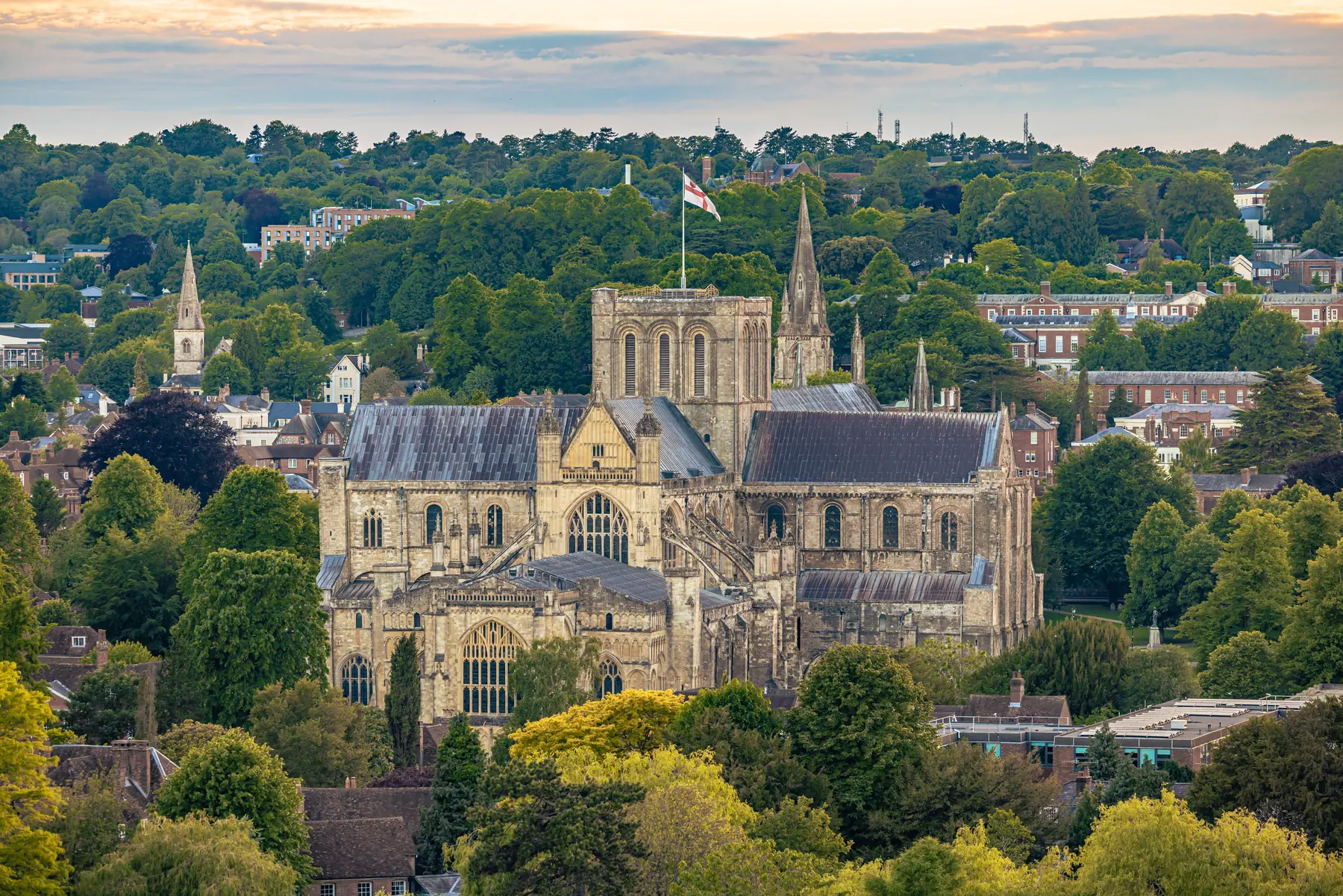
Worth doing with children, with the right expectations. It is enormous, it is one of the longest cathedrals in Europe, and it has some good hooks: the medieval floor tiles, the crypt — which floods in winter, with Antony Gormley’s standing figure up to its knees in water — the Winchester Bible, and the story of William Walker, the diver who spent six years underwater shoring up the foundations single-handed between 1906 and 1911 and saved the whole building.
That last story is the one that lands with children. Our cathedral guide has more.
Four hundred metres from the High Street, a wetland reserve with boardwalks over reedbed and river. Kingfishers, water voles and, if you are lucky, otters.
The water meadows south of the city, on the walk to St Cross, are level, full of clear water and easy with children of any age.
Two kilometres out. A steep flight of steps up a chalk hill to an Iron Age hillfort, with a mizmaze — a turf labyrinth cut into the ground — near the top, and the whole city laid out below. The steps are the point as far as most children are concerned.
The Watercress Line, at New Alresford eleven kilometres east, is a heritage steam railway running sixteen kilometres to Alton through the Hampshire countryside. Full days out with Thomas events, dining trains and the usual heritage railway apparatus.
Intech, Marwell and the Watercress Line between them will fill three days.
Portsmouth Historic Dockyard, forty minutes south, has the Mary Rose, HMS Victory and HMS Warrior. The New Forest is forty minutes south-west with ponies on the road. Paultons Park with Peppa Pig World is half an hour away and is the theme park of choice for younger children in this part of Hampshire.
The Science Centre is the obvious answer, and a good one. Beyond it: the cathedral, the Great Hall, the City Museum, the Westgate Museum and the three military museums at Peninsula Barracks are all indoors and all within a few minutes of each other. Our wet weather guide has the list.
Winchester has an unusually good food scene for its size and most of it is family-friendly — the Wykeham Arms, the City Mill area and the restaurants along Jewry Street and the High Street all cope well. There is a good market and a farmers’ market twice a month. Our eating guide has more.
Getting here. Winchester is on the main line from London Waterloo — about an hour — with four trains an hour, and ten minutes from Southampton Airport Parkway. The station is a ten-minute walk from the High Street.
Parking. There are park and ride sites on the edges, which are the sensible option; the city-centre car parks fill.
The city is compact. The cathedral, the Great Hall, the City Mill and Winnall Moors are all within fifteen minutes’ walk of each other.
Hills. St Catherine’s and St Giles are steep; everything else in the city is flat.
A city day. Start at the Great Hall for the Round Table — fifteen minutes, and the best hook in Winchester. Down the High Street past the Buttercross to the City Mill for the milling demonstration and the otter cam. Lunch. Then the water meadows walk to St Cross, asking for the Wayfarer’s Dole at the porter’s lodge, and back over St Catherine’s Hill for the mizmaze and the view. Everything free or nearly so.
An out-of-town day. Marwell Zoo for a full day, or the Science Centre in the morning and the Watercress Line in the afternoon — a planetarium and a steam train, which covers most children’s requirements.
Under five: the City Mill, Winnall Moors’ boardwalks, the water meadows, Marwell’s play areas.
Five to eleven: the sweet spot. The Science Centre and planetarium, Marwell, the Round Table, the Watercress Line, St Catherine’s Hill.
Teenagers: the cathedral tower tour, Portsmouth Historic Dockyard, the South Downs Way, and cycling in the New Forest.
Marwell Zoo for a full day; the Science Centre and Planetarium when it rains; the Round Table in the Great Hall for half an hour that they will remember.
No. It was made around 1290, probably for Edward I, and repainted for Henry VIII in 1516. It is still six metres across and hanging on a wall, which is the part that matters at eight years old.
Eight kilometres south at Colden Common, about fifteen minutes by road.
The Watercress Line at New Alresford, eleven kilometres east, running sixteen kilometres to Alton.
Yes, with the right hooks — the flooded crypt, the medieval tiles and the story of the diver who saved the building.