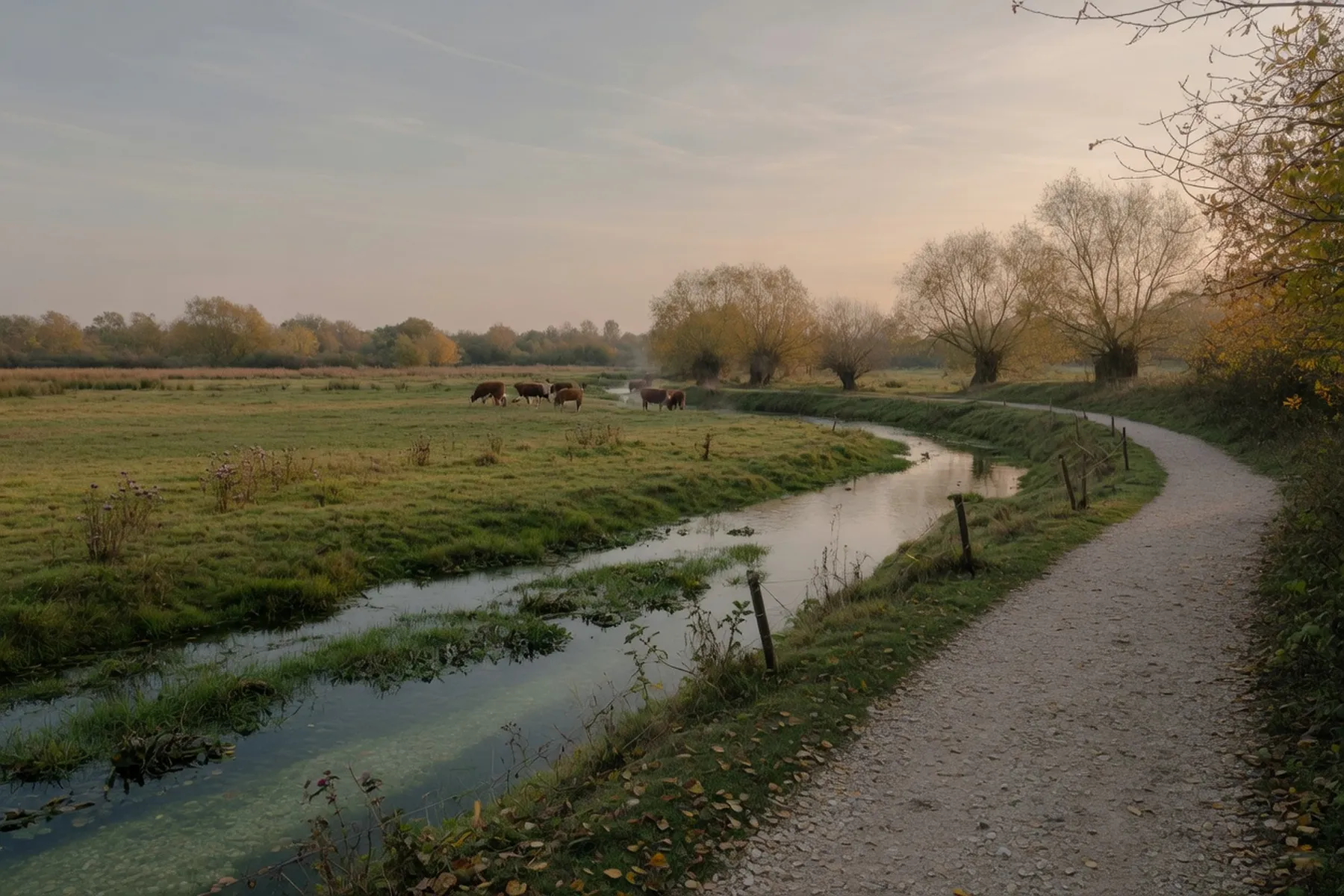
Winchester keeps two of its oldest institutions on the quiet south side of the Itchen, beyond the cathedral close. The Hospital of St Cross has given travellers bread and ale since the twelfth century, and it still does. Winchester College has run continuously since the fourteenth century. A two-mile water-meadow walk joins them, the walk John Keats took daily in the autumn of 1819 while he was writing “To Autumn”.
St Cross is England’s oldest charitable institution, founded in 1136 and still functioning as an almshouse. Simon Jenkins called it “England’s most perfect almshouse”. The hospital’s visiting page lists what a ticket opens: the Church, the Brethren’s Hall, the Old Kitchen and the Master’s Garden, with the Compton Garden among it. The address is St Cross Road, SO23 9SD. The hospital’s own directions describe a scenic twenty-to-thirty-minute walk from the cathedral or city centre through the water meadows, and that walk is the right way in.
The Dole is still given, and it is the original arrangement: a horn of beer and a morsel of bread, a tradition founded by a Cluniac monk. The Keats Walk leaflet calls it bread and ale given to travellers since the almshouse was founded. Ask at the Porter’s Lodge on departure.
Tickets are bought at the Porter’s Lodge under the archway. In the summer and autumn season, 1 April to 31 October, the hospital opens Monday to Saturday 09:30 to 17:00 and Sunday 13:00 to 17:00. From 1 November to 31 March it opens Monday to Saturday 10:30 to 15:30 and is closed on Sundays except for church services. Admission in 2026 is £7.50 for adults, £5.00 for students and seniors, £4.00 for children under 13, and registered carers go free when accompanying a disabled visitor; Gift Aid adds 50p to each ticket. Dogs stay in the Outer Quad only, assistance dogs excepted. Check the opening-times page before you come.
In summer the two fit in a single day: see St Cross first, then walk back for the college’s 3.30pm tour. In winter, reverse the order or split the day. St Cross shuts at 15:30 through those months, and the Sunday closure means a winter visit needs a weekday.
The Brethren’s Hall is the room to linger in: a central hearth, the Master’s stairs, a dais and a musician’s gallery. The Victorian Old Kitchen, the meat room and the cellar are open as well. Private events can close areas without much notice, so the hospital asks you to call the Lodge first if one particular room matters to you. The Master’s Garden and the Compton Garden round out the circuit.
The Hundred Men’s Hall tearoom is volunteer-staffed, serving cakes and drinks with lawn seating in fine weather. From 1 April to 31 October it runs Monday to Saturday 10:30 to 16:30 and Sunday 13:00 to 16:30. Through the spring weeks from 2 March to 31 March it opens Monday to Saturday 10:30 to 15:30, and the hospital describes the provision then as limited. Groups of ten or more should pre-book.
Guided tours are pre-booked only and delivered by a Brother in traditional gown and trencher hat, lasting over an hour. They run twice daily at 11:00 and 14:00, never on Wednesday mornings or Sundays. Each tour costs £20 on top of normal admission, with a maximum of 25 people per tour and up to 50 in a group. Book through Porter Roger Ossa Trivino on 01962 851375 or [email protected]; there is a gift shop in the Porter’s Lodge, and groups of twenty or more should pay for tearoom refreshments in advance. Chapel tower tours are separate: £20, a maximum of six, ages 12 and over, sure-footed only, with narrow spiral stairs, ladders and a waiver, booked through the hospital’s TryBooking page.
Winchester College was founded in 1382 by Bishop William of Wykeham, and the Keats Walk leaflet from Visit Winchester and the city council calls it the oldest continuously running public school in England. The college dates its medieval architecture to 1387 and stresses that it remains in daily use. You enter at the Porters’ Lodge on College Street, SO23 9NA; from the centre, walk through the Cathedral Close to St Swithun’s Street, left under Kingsgate Arch and bear left into College Street.
Daily College tours last one hour and run at 2.15pm and 3.30pm every day of the week. The usual highlights are the medieval Chamber Court, the fourteenth-century Gothic chapel, College Hall, the medieval Cloisters and the seventeenth-century redbrick schoolroom. In winter the times move to 1.45pm and 3.00pm to fit reduced daylight; the college’s FAQ page says the tours are currently at the earlier winter setting, so check the current time on the tours page before you set out. Tickets from 1 September 2026 are £13.65 for adults and £12.80 for concessions, and the page does not define a concession — ask at booking. Book ahead through the college’s TryBooking page; walk-ups may be possible if there is space.
The Treasury, the school museum in the medieval Warden’s stables, is the free way in: open daily 14:00 to 16:00 with no booking, closing from 24 December to 1 January inclusive and reopening on 2 January. The collections range from Egyptian, Greek and Roman antiquities to medieval art, Chinese ceramics, paintings and early English silver, with temporary exhibitions — a Greek vases exhibition runs until 23 December 2026 — and children’s trails. Three of the four galleries are wheelchair accessible and there is a disabled toilet.
Specialist tours run roughly monthly, booked through the college’s what’s-on page: Archives with the Archivist, Treasures through the works of art and the Fellows’ Library, the War Cloister — which the college calls the largest private war memorial in Europe — and Garden tours with the gardening team, about an hour and a half, from April to September. Bookings of ten or more go through the Tours Coordinator on 01962 621 209, and groups can number up to sixty.
The Keats Walk leaflet, published by Visit Winchester with the city council, starts at the visitor information centre in the Victorian Guildhall, beside the King Alfred statue. It runs up the High Street and Market Street, past Winchester Cathedral, through the Inner Close and St Swithun’s Gate, under Kingsgate and into College Street. No. 8 College Street is where Jane Austen spent her last weeks and died on 18 July 1817; the house is private and not open. Past the college, turn right into College Walk and the meadows open out along a chalk stream of the Itchen, with trout, moorhens and wild flowers, the college cricket pitches on the right and St Catherine’s Hill ahead.
Keats stayed in Winchester in the late summer and early autumn of 1819 and wrote “To Autumn” on Sunday 19 September 1819. He described St Cross as “a very interesting old place, both for its gothic tower and alms-square”. The leaflet puts the round trip at roughly two miles on pavements, gravel paths and grass: after half a mile you cross Garnier Road and carry on a further quarter of a mile to the hospital. Coming back, retrace the meadows or take the paved route along Back Street, St Faith’s Road, Kingsgate Road and Kingsgate Street; St Cross Road is also paved and has buses. Near the head of College Street sits the present-day bishop’s palace at Wolvesey, with the ruins of Wolvesey Castle beyond — worth a detour on the way out. More meadow routes are in the walks guide.
St Cross has little parking — the hospital’s directions page speaks of limited space, roughly ten cars along the driveway — so the meadow walk in is the honest option, and the Bluestar No. 1 bus serves the area; check the operator’s current timetable. Winchester College has no on-site parking, though Blue Badge holders may park free on College Street or College Walk if a space is free. The college campus is historic, with cobbles and steps on parts of the tours, and it asks you to contact the college in advance about access needs; the hospital says disabled access covers every part of the Brother-led tour. Unaccompanied visits to the rest of the school are not permitted — you see it by tour or through the Treasury. On the meadows, stay on the designated footpaths; dogs go on leads when livestock are present, the Itchen here is a Site of Special Scientific Interest and a Special Area of Conservation, and paddling is allowed only at one designated spot.
The hospital’s Michaelmas Fair fills the grounds on Saturday 26 September 2026, 10:30 to 16:30, with the Hounds of Morrigan medieval encampment running from the Battle of Hastings to the Wars of the Roses, traditional games, music from Courtlye Musick and the Rock Choir, and about nineteen stalls of makers, traders and charity tombolas. Entry is £4, under-16s free, dogs welcome — check the hospital’s events page for anything that changes. Later the hospital runs an English Choral Workshop Weekend on 17–18 October and concerts through November and December, with St Swithun’s Prep carol concert on 11 December and further concerts just after mid-December.
The college’s specialist tours this autumn and winter run on fixed dates: the War Cloister tour on 3 October, 7 November and 5 December; Archives on 5 October, 3 November and 1 December; and Treasures on 7 December, with an RSN Festive Embroidery Workshop on 21 November. Confirm dates and booking on the college’s what’s-on page, as programmes shift.