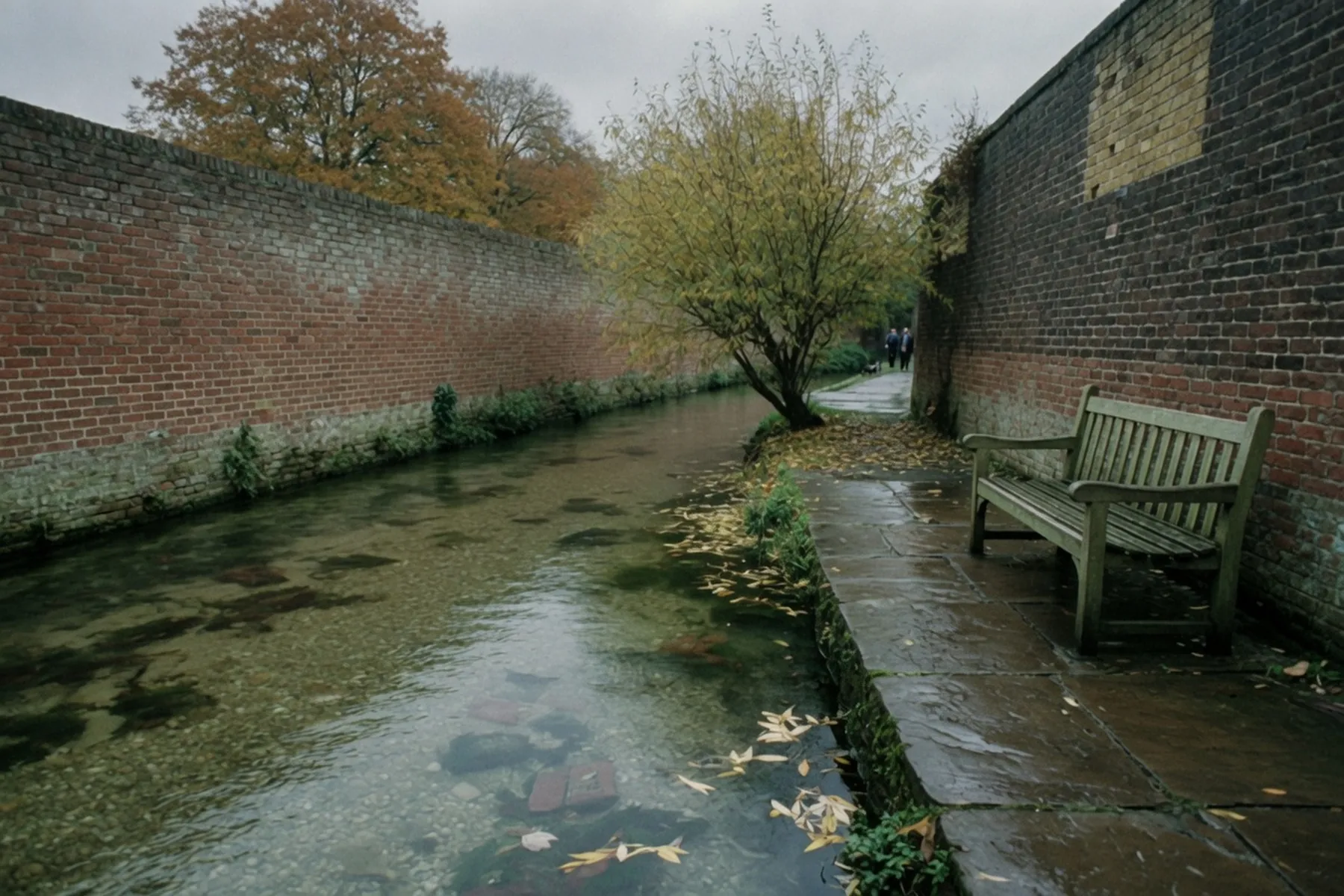
Winchester City Mill sits on Bridge Street, at the bottom of the High Street, where the Itchen is forced under the road. It is a National Trust mill, free to walk into, and it is not currently grinding flour. That last point is the one most websites still get wrong.
In February 2023 the National Trust declared the waterwheel unfit to run. It had worked since 2003, through flood years the Trust says have shortened its life. Fundraising hit its target and restoration is underway. The Trust’s mill-wheel page, as of this writing, expects spring 2027 for a turning wheel and flour off the stones. Check that page; a millwright’s programme moves.
Until then the mill race is closed, and so is part of the Island Garden. A temporary flume keeps some water moving through the race so fish and other wildlife can still pass — the mill’s own Facebook page is the source for that. You can still walk into the mill, look at the machinery that is on show, watch the otter cameras, buy a second-hand book, and sit with a scone over the river. Volunteers give short tours when they are free. The Welcome Space has films of the milling process for the months the wheel is out.
When it runs, this is an undershot wheel in the left-hand millrace, turned by the Itchen on wooden paddles at about seven or eight revolutions a minute, with gears stepping the millstones up to around sixty. AccessAble’s guide notes that the machinery section downstairs may stay closed through the 2026 and 2027 works. Do not count on standing over the water. Ask on the day.
A mill has stood here since at least the Saxon period. The Trust’s history page notes records from 932 and 989, when a watermill here belonged to the nunnery at Wherwell, and it reads the foundations as suggesting an earlier Roman mill. In the Domesday survey of 1086 the mill returned a rent of 48 shillings. By 1471 it was recorded as derelict. After the Dissolution it passed to the Crown. Mary Tudor gave it to the city in 1554, after her wedding in Winchester Cathedral.
The building you look at is James Cooke’s rebuild. The Trust says he began in 1743; Historic England’s list entry, Grade II*, names it “1, Water Lane”, first listed on 24 March 1950, and dates the mill 1744. Cooke kept older timbers — the Trust puts many of them in the fourteenth and fifteenth centuries. John Benham bought it in 1820; the family milled corn here until the early 1900s. A laundry occupied it in the First World War. In 1928 local benefactors saved it from demolition and gave it to the National Trust. From 1931 until 2004 part of it was a youth hostel. Milling came back in public in March 2004, after millwright Ian Clark spent a winter on the machinery, and after a gap of around ninety years.
In 1994 three otters were put back on the Itchen. The Trust and the Hampshire and Isle of Wight Wildlife Trust put cameras in in the late 1990s. Motion-activated kits still catch otters coming out from under the mill. You watch a live feed and a reel of archive clips. Live sightings happen; the archive is the honest fallback.
From the garden, when it is open, you are looking at a chalk stream: trout in the clear water, kingfishers off the walls, grey wagtails, water voles if you are still. Dawn and dusk are better than noon.
The café is inside the mill. Bakes come off the kitchen each day; the scone of the month is the running joke; Jude’s ice cream is the Hampshire tub. Profits go back into the building, which at the moment means the wheel. The second-hand bookshop is donated stock; money from it stays with the mill.
The Island Garden sits behind the back door, water on both sides. The Trust’s notice, the day this was written, had part of it closed for the wheel works. Four steps up into the mill room; more steps down to the garden. Buggies can come into the mill room. The Trust asks you not to take them into the garden or the mill race. Assistance dogs only.
Entry is free. That is the Trust’s current wording, not a member perk. Older guides still quote a ticket; they are describing a previous arrangement. Donations toward the wheel are welcome.
Hours are not a simple open-every-day. The Trust’s calendar for Wednesday 9 September 2026 showed the site closed. The mill’s Facebook intro, the same week, gave Thursday to Sunday, 10am to 4pm. Use the opening-times widget on the National Trust mill page the morning you come. Do not build a Monday around it.
The way in is a low-gradient ramp from the front courtyard, then stairs with a handrail into the mill space and down toward the race and the garden. The Trust flags steps and uneven ground. There is an accessible toilet. The nearest Changing Places toilet it lists is at The Arc on Jewry Street. Remaining dates for miller talks and Turn the Quern sessions sit on the Trust events listing.
There is no mill car park. The Trust is blunt: do not type the postcode into a satnav and expect a bay.
Chesil Street Multi Storey, on Barfield Close, is the nearest council park — 616 spaces, park-and-walk, first hour free, free on Sundays and evenings on the council’s Zone 2 rules. Our parking guide is the longer argument. Confirm charges on the council parking page.
Monday to Saturday, park and ride is the cleaner arrival. Five sites, 2137 spaces on the council page. The Trust names St Catherine’s specifically. From Barfield the council describes an eleven-minute walk along the Itchen into the centre, which puts you on the river at the mill. Park-and-ride buses do not run on Sundays or bank holidays; the car parks themselves stay open. Winchester station is one mile away on the Trust’s own figure. The High Street drops you at the Broadway and the Alfred statue. Cycle parking is on-street, about fifty metres off, at Bridge Street and Eastgate Street.
Turn south and the river is the city wall. The path along this stretch is the Weirs: water one side, flint the other, the cathedral roof showing over the wall. It is a few minutes from the Broadway. The longer river day is in our Itchen guide.
Wolvesey Castle, the ruined palace of the Bishops of Winchester, sits on the inside of those walls. English Heritage, free. As of the English Heritage page it is open daily, 10am–5pm from 1 April to 30 September, then 10am–4pm from 1 October to 31 March. Surfaces are uneven and the site can flood after heavy rain; it may shut at short notice. Dogs on leads. Colebrook Street is the park English Heritage names, a five-minute walk. Mary and Philip of Spain held their wedding banquet here on 25 July 1554, the same visit that put this mill into the city’s hands.
Abbey Gardens sit the other way, between Alfred and the back of the cathedral, with the Itchen in channels through the lawns. The cathedral itself is a river building: the crypt floods because the water table is this high. For the nave, the Bible and the crypt, use the cathedral guide.
The mill is the official western start of the South Downs Way. The South Downs National Park Authority and the National Trust put a permanent marker here in 2017. The trail runs 100 miles, 160 kilometres, along the chalk to Eastbourne. Visit Winchester notes that the physical marker stands in the mill grounds, so if the mill is shut that day the Alfred statue is the photograph instead. Distances and the first miles east are in the walks guide.
Upstream is quieter. Winnall Moors is a short walk north of the mill, a chalk-stream floodplain reserve managed by the Hampshire and Isle of Wight Wildlife Trust, with boardwalks over reed and wet grass. Free. Winter flooding is what the meadows are for; after heavy rain the boardwalks can be the dry line.
September is the Keats month on the water meadows south of the college, and it is also when the city opens doors. Heritage Open Days run 11–20 September 2026, organised locally by Hampshire History Trust as part of the national scheme. The mill’s miller talks sit on Saturday 19 and Sunday 20 September, 10:00 to 16:00 — free, donations welcome, volunteer-led. Confirm on the organiser’s Winchester listings and on the Trust events page; hours move.
The same week, Winchester Cathedral is hanging Wild!, a festival of flowers and nature, 15–19 September 2026. The cathedral’s own site warned that some areas would be limited from 9 to 15 September while it went in. Read the cathedral events page if you are combining the two.
From Friday 20 November to Tuesday 22 December 2026 the cathedral close holds the Christmas Market. Entry is free; the cathedral publishes Friday–Saturday 10.00am–8.00pm and Sunday–Thursday 10.00am–6.00pm, and asks you to check that page. The mill, if the Trust has it open that day, is the indoor hour on the river before or after the chalets — check the Trust opening-times widget rather than assuming a December afternoon. October half-term, on Visit Winchester’s listing, runs Saturday 24 October to Sunday 1 November 2026. The rain guide is the wet-weather list.