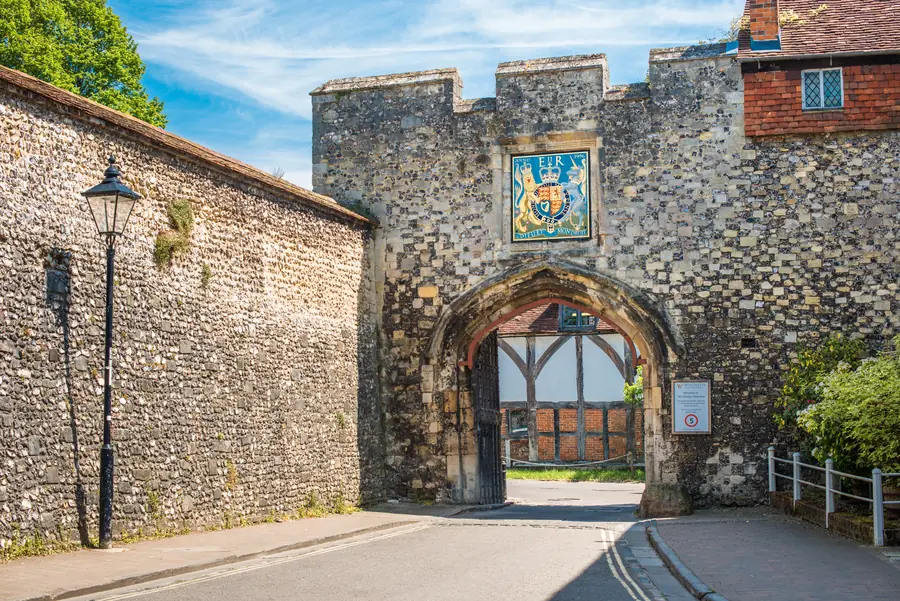
Winchester is one of the few cathedral cities where leaving the car at home is a plan rather than a dare. The station is ten to fifteen minutes downhill from the High Street. The cathedral, the Close, the Great Hall, the mill and the river sit inside a walk you could do between breakfast and lunch. Park-and-ride buses exist for people who drove to the edge. You are not those people.
This is the car-free day. The parking article is the other one.
Take the train from London Waterloo. About an hour, into Winchester station, walk downhill. Do the city on foot. Use a bus or a taxi only if you are going to Marwell or the Science Centre. On Sunday the park-and-ride buses do not run; the train still does, which is the whole argument.
Frequencies change. National Rail is the document to trust. Our getting here page is the Waterloo train into the station on the western hill.
Winchester sits on the South Western main line. From Waterloo the journey is about an hour. Pattern has been several trains an hour; operators adjust, so check the day you travel. Direct services also run from Southampton in around a quarter of an hour; Southampton Airport Parkway is the stop before.
The station is on the hill west of the centre. Out of the front, you are looking down toward the city. City Road and the High Street take you to the Westgate and then downhill to the Buttercross, the Broadway and King Alfred. Ten minutes if you are brisk and know the way; fifteen with a bag. It is a descent. The walk back to the train is the climb. Leave time for that if you have a timed return, especially with children or a suitcase.
There is a station car park. You do not need it. Coming from the south coast, Southampton is the useful interchange. Our day trips guide is where those connections actually get you. Shawford, a few minutes down the line, is the station for a linear walk back along the Itchen.
This is the argument for not bringing a car.
From the Westgate at the top of the High Street to Alfred at the bottom is a pedestrianised Saxon street, fifteen minutes end to end if you do not go into anything. The Great Hall is immediately behind the Westgate — one room, the Round Table on the wall, Queen Eleanor’s Garden beside it. The Buttercross stands in the middle of the street. The Broadway opens at the bottom, with the statue, Abbey Gardens, the bus station and the mill on the river.
The cathedral sits south of that line, in the largest close in England. Wolvesey, the college, Kingsgate and the Weirs hang off the east side. Winnall Moors is four hundred metres north of the High Street. St Giles Hill is ten to twenty minutes up from the Broadway. None of this requires transport. Our walks guide and the Itchen piece cover the ground.
Hills are the catch, and they are modest. The station is up; St Giles and St Catherine’s are up; everything between the Westgate and the mill is close to flat. Luggage and buggies need a pause at the Westgate on the way back. Once you are on the High Street, you do not need transport until you leave it.
Winchester’s park-and-ride buses do not run on Sundays or bank holidays. That is a problem for people who drove to South Winchester and expected a green bus into the Broadway. It is not a problem for you.
The train runs. The city walks. The cathedral is a working church and open, with the usual service caveats. The mill café on the river has been opening through the week on a late-2026 snapshot — check the National Trust page, because the wheel replacement has been shutting parts of the building. Wolvesey is seasonal; a Sunday in February may find it closed.
What Sunday does change is the feel: fewer commuters, the Close in use for worship. Evensong is still the free hour. The when to visit page is the calendar; this page is only saying the car-free plan does not collapse when the park-and-ride buses do. Arrive on an early train in the holidays.
Winchester is built for this, which is why Waterloo empties onto the platform.
The arithmetic. Out around nine, in the city by ten. Cathedral until lunch — two hours minimum, three to do it properly, and check evensong so you do not collide with it. Lunch on Jewry Street or in Abbey Gardens. Great Hall and the Round Table after, which is half an hour. Down the High Street to Alfred, the mill if it is open, the Weirs or St Giles Hill for the view. Train back late afternoon. You have walked two kilometres and two thousand years, and you have not thought about a car park.
That is a full day. It is not a rushed dash. People who add Marwell, the Science Centre and St Cross as if they were adjacent rooms miss the nave.
Two nights is when the city breathes. Evening in the Wykeham Arms, morning on the meadows, the hill at sunset. Our eating guide and St Giles Hill are those hours. Cathedral admission on the cathedral’s own site; the hall has long been free or by small donation — check on arrival; the mill is free-entry on current Trust wording; evensong is free.
Honesty is the point of this section.
Marwell Zoo is eight kilometres south at Colden Common, 140 acres, a full day. It is not on the compact circuit. There are buses from the station toward that side of Hampshire; timetables move with school days and Sundays. Look up the current service on Traveline or Stagecoach the night before, or budget for a taxi. Do not walk it. Our family guide is the rest of that day.
Winchester Science Centre and Planetarium sits east of the city at Morn Hill, off the A31. It is a hill, not a street. Keen walkers can get there along the Alresford Road; most families will want a bus or a taxi. The planetarium is the wet-day answer for children, and it is worth the extra hop if that is the day you are having. It is not a spontaneous add-on between the crypt and the hall.
Old Winchester Hill, despite the name, is not near Winchester. It is a national nature reserve in the Meon valley, eighteen kilometres south-east. The day trips page is blunt: it wants a car, or a bus into the valley and a walk. Do not put it on a Waterloo day trip.
The Watercress Line at New Alresford is a heritage railway, eleven kilometres east. Buses run that way. It is a half-day on top of a connection, not a stroll from the Close. City buses cover the ordinary work of a county town; they are not a visitor network in the London sense.
St Catherine’s Hill is two kilometres south-east, a steep climb from the water meadows, and entirely walkable from the cathedral. No bus required. Chalk steps, a hillfort, a turf maze, the city below. Give it an hour, more with St Cross.
The South Downs Way starts at the City Mill. The first section is a city river and then open downland. You can walk out and bus back from the Meon valley, or turn round when you have had enough. St Giles Hill is the short view, from the Broadway, no transport, twenty minutes. Winnall Moors is four hundred metres from the High Street. Boardwalks, reedbed, the same river. Free.
What walking does not do: Marwell, the planetarium as a casual extra, Old Winchester Hill, the New Forest. Several of those are trains rather than cars — Portsmouth Harbour for the dockyard, Brockenhurst for the Forest. The car-free week is a city plus rail. It is not every attraction in Hampshire.
If someone else is driving, or if you hired a car for the rest of Hampshire, read parking in Winchester before you enter the one-way system. Park and ride is the visitor plan Monday to Saturday. Chesil Street is the Sunday plan. Zone 1 by the Close is the trap.
What the car is actually for: Marwell with small children, the Science Centre when the bus looks thin, Old Winchester Hill at dusk. What it is not for: the cathedral, the hall, Alfred, Abbey Gardens, the mill, the Weirs, St Giles, Winnall. For those, the car is something you then have to park.
Winchester is a walking city with a main-line station. The train’s job is to reach the hill. After that, the day belongs to the streets.